
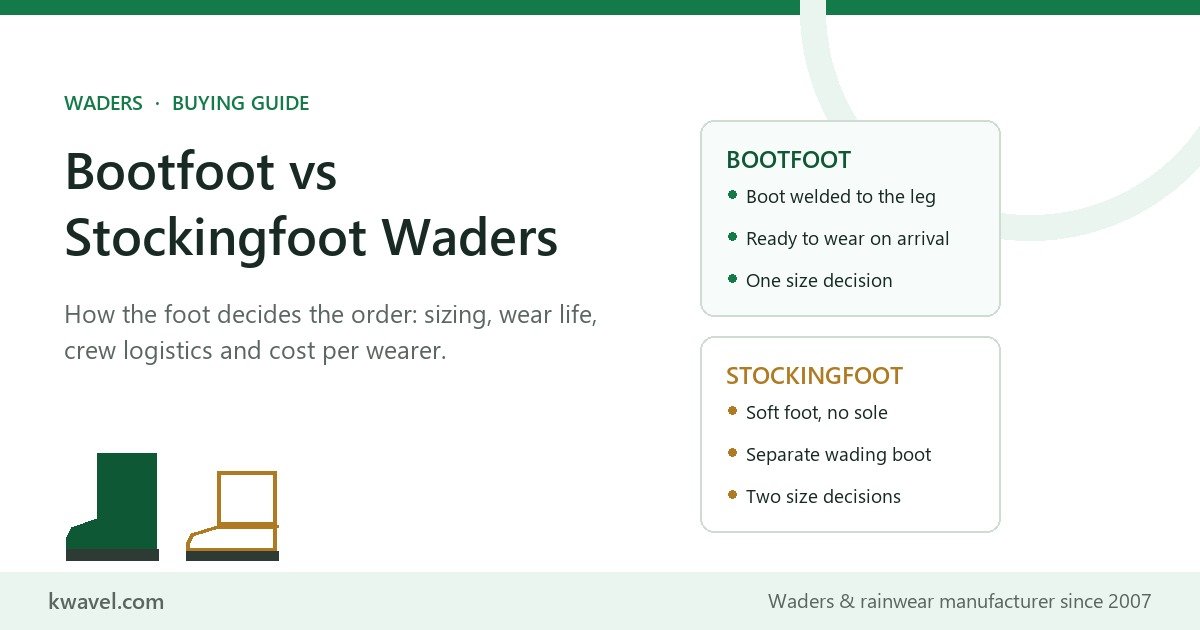
Bootfoot vs stockingfoot waders is the first decision in almost every wader order, and it is not a fashion choice. The two designs differ at one point — how the foot is built — and that single difference changes what a wearer has to buy, how the pair is sized, how it dries, what it costs to replace, and how many returns a distributor sees in the first season. This guide compares them on the criteria that decide a purchase order rather than a weekend trip: sizing risk, wear life, crew logistics and cost per wearer.
One disclosure before the comparison, because it saves time: Kwavel manufactures bootfoot waders. We do not make stockingfoot waders, and we are not going to pretend the two are interchangeable. What follows is the honest split, including the cases where a stockingfoot pair is the better buy and where our own range cannot help you.
1. The One Real Difference: How the Foot Is Built
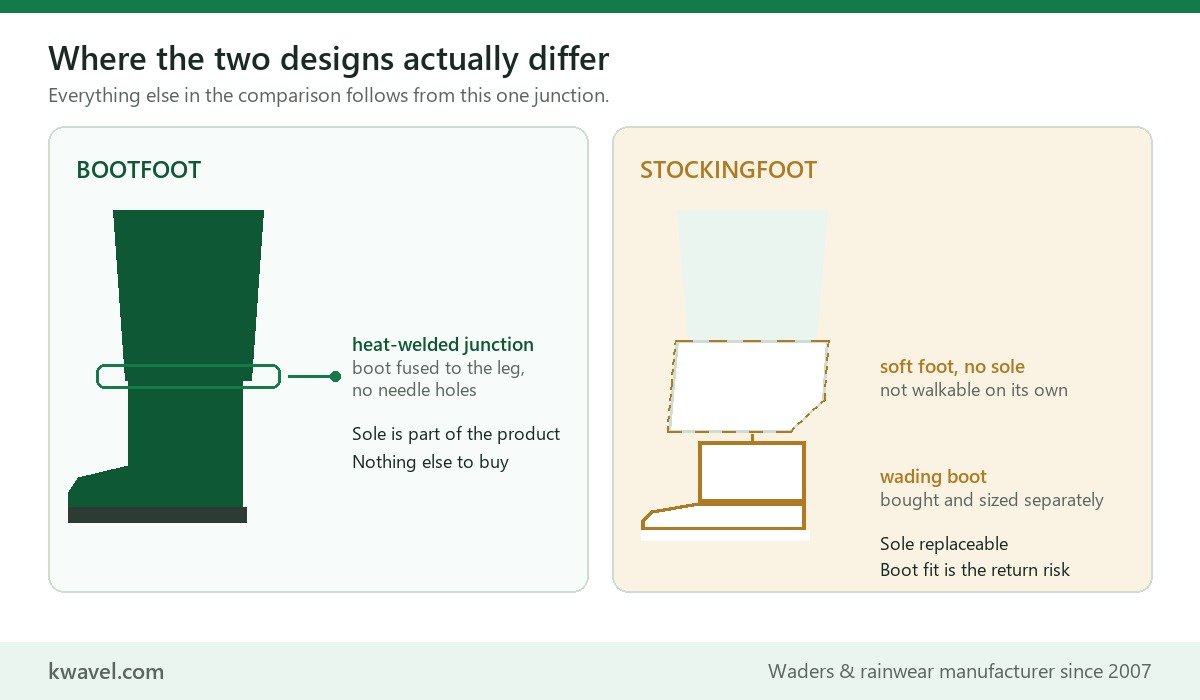
Everything downstream comes from the foot junction.
On a bootfoot wader, the boot is permanently joined to the leg. The buyer chooses one size, the pair arrives complete, and nothing else has to be bought, matched or carried. The junction is the structural weak point of the design, so how it is made matters more than any other feature: heat-welded junctions fuse the boot and the leg into one waterproof surface, while stitched junctions punch needle holes through a waterproof material and rely on seam tape to close them again.
On a stockingfoot wader, the leg ends in a soft, sock-like foot with no sole. It is worn inside a separate wading boot, which the buyer supplies. That gives the wearer a laced boot with ankle support and a replaceable sole — at the cost of a second purchase, a second sizing decision and a boot-to-foot interface that has to be got right.
Those are the only two differences that matter. Every advantage listed below is a consequence of one of them.
2. Bootfoot Waders: What You Gain, What You Give Up
What you gain
- One decision, one size. The wader size is the boot size. There is no separate boot to match, and no mismatch between the foot and the boot to return. For a distributor, this halves the number of ways an order can go wrong.
- Nothing else to buy. The pair is ready to wear out of the box. For a farm, a construction crew or a municipal maintenance team, that is the whole point — nobody has to source boots in 14 different sizes before the crew can work.
- Mud, sand and gravel stay outside. There is no boot opening for grit to fall into. On beaches, riverbanks, building sites and shrimp ponds, this is the difference between uncomfortable and unusable by mid-morning.
- Warmer in cold water. One continuous layer over the foot, with no wet boot to wring out. For winter work and cold-water fishing, bootfoot wins on comfort without any extra product.
- Faster to clean and dry. The inside can be rinsed and hung; there is no separate boot to remove, drain and dry. Fleets that issue waders to rotating staff care about this more than they expect.
- Soles built for real ground. Because the boot is part of the product, the manufacturer can specify a thick lug or cleated sole — our PVC models use a thickened rhino-pattern anti-slip sole, and the nylon models are offered with either a German-style or a light sports boot. The PVC chest waders with injection boots are the model most crews start with.
The lightweight nylon chest waders are the nylon side of that choice — the same two boot options, in EU 36–46.
What you give up
- Weight on the leg. A bootfoot pair is heavier than a stockingfoot pair plus a lightweight boot, and the weight sits lower on the foot where it is felt most. Long walks are the weak point, and pretending otherwise loses credibility with anyone who has done one.
- Less ankle support. A moulded boot cannot be laced tight. On rock, scree and steep banks a laced wading boot is genuinely better.
- The boot usually dies first. The sole and the heel wear through long before the fabric does. On a fixed model the whole pair then has to be replaced, whereas a stockingfoot wearer replaces only the boots.
- Two sizes are locked together. A wearer with a wide foot and a narrow calf, or a very long foot and a short body, has less freedom than with two separate items. Our size tables account for this with a fits-height row, but a fixed boot does not adapt.
- Bulk in transit. Bootfoot pairs take more carton volume per unit than stockingfoot waders shipped without boots. For sea freight and warehouse space, it is a real line in the costing.
3. Stockingfoot Waders: What You Gain, What You Give Up
What you gain
- Ankle support from a real boot. Laced wading boots hold the ankle and grip rock, and they come in half sizes and widths. For anyone walking over uneven ground or wading a rocky river, this is the main reason to choose the design.
- Lighter and more packable. The wader packs down small and the boot can be a light one. For travel, air freight and guides carrying gear to a boat, that matters.
- Replaceable boots. When the sole wears out — and it will — the wearer buys boots, not waders. Over several seasons this is the cheapest way to keep one person in the water.
- Fit freedom. Foot and leg are sized separately, which suits unusual proportions better than a fixed boot.
What you give up
- Two purchases, higher entry cost. The wader alone is not usable. Add boots, and often gravel guards, and the total per wearer rises well above a comparable bootfoot pair.
- The boot-to-sock interface is the return risk. Buy the wrong boot size over a soft foot and the wearer gets rubbing, a loose heel or a cramped toe. This is the single most common complaint in the category, and it is a sizing problem no manufacturer can absorb for the buyer.
- Grit gets in. The top of the boot is an opening. Sand and fine gravel work their way in and stay there. Gravel guards reduce it; nothing eliminates it.
- Slower to dry and to clean. Two components, both damp, both needing space.
- A fragile foot. The soft foot abrades quickly against grit inside the boot and against rough ground if worn without one. It is not a component to walk on in a car park.
4. Bootfoot vs Stockingfoot Waders: Side by Side
| Criterion | Bootfoot | Stockingfoot |
|---|---|---|
| What the buyer purchases | One item, complete | Wader plus wading boots (plus gravel guards) |
| Sizing decisions | One (EU boot size) | Two (soft foot size and boot size) |
| Ready to wear on arrival | Yes | No — boots must be bought and fitted |
| Total cost per wearer | Lower | Higher |
| Weight on the foot | Heavier | Lighter |
| Ankle support | Moderate, fixed boot | Good, laced boot |
| Long walks and rough ground | Weak point | Strong point |
| Mud, sand and gravel | Sealed, nothing gets in | Enters at the boot opening |
| Warmth in cold water | Warmer | Cooler |
| Drying and cleaning | One piece, fast | Two pieces, slower |
| When the sole wears out | Replace the pair | Replace the boots |
| Carton volume in bulk | Higher | Lower |
| Best suited to | Work crews, farms, aquaculture, flood response, cold water, distributors | Travelling anglers, rocky rivers, long approaches, wearers who already own boots |
5. The Sizing Difference Nobody Warns You About
Bootfoot sizing is one number, and it is the boot size. The wearer measures foot length, converts to EU, and that is the wader size — the garment measurements are listed next to it so height and girth can be checked in the same table. Our range runs EU 22–36 for kids, 37–41 for women and 36–47 for men, with the full method and conversion tables in our wader sizing guide.
Stockingfoot sizing is two numbers on two different scales. The soft foot is usually sold in S–XXL bands keyed to shoe size, and the boot is sold in its own size, and the two do not have to agree. A wearer who takes a 44 in a work boot may need a 45 in a wading boot over the foot — or the opposite, depending on the boot. Every one of those mismatch cases is a return, and none of them exist when the boot is part of the wader.
Two further points that apply to both designs. Buyers above the standard range should start from the extended pattern rather than sizing up a standard one, as set out in our plus size waders guide. And the fabric choice — PVC against nylon or Taslan — affects weight and packability as much as the foot design does, which is worth reading before a large order: see PVC vs nylon waders.
In hot climates the body fabric matters as much as the foot: a Taslan chest wader with breathable mesh lining moves air far better than a solid PVC body.
6. Which One for Which Buyer
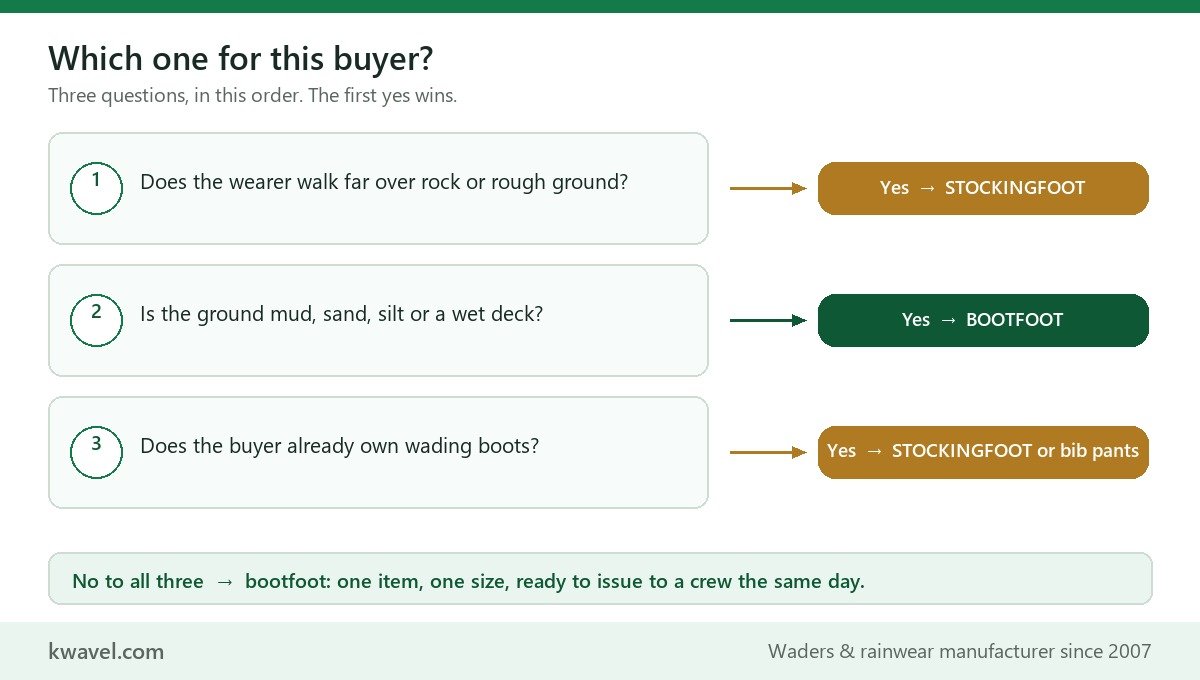
The pattern is consistent once you look at the job rather than the product.
| Buyer or use | Usual choice | Why |
|---|---|---|
| Farm, dairy and field staff | Bootfoot | Mud, hose-down cleaning, no boot sourcing, one size per person |
| Aquaculture and pond work | Bootfoot | Standing depth, silt, constant on-and-off between tasks |
| Construction and flood cleanup | Bootfoot | Debris on the ground, puncture risk, fast issue to a crew |
| Municipal or rental fleet | Bootfoot | Easier to rinse and reissue; no boot inventory to manage |
| Distributor stocking a region | Bootfoot | Fewer SKUs, fewer return causes, simpler catalogue |
| Fishing guide working from a boat | Either | Bootfoot for wet decks; stockingfoot if the day includes walking |
| Travelling angler, long approaches | Stockingfoot | Packable, laced boot, replaceable sole |
| Rocky river, fast water | Stockingfoot | Ankle support and grip on uneven ground |
| Wearer who already owns wading boots | Stockingfoot, or bib pants | No reason to pay twice for footwear |
That last row is the one we can still serve from a bootfoot factory. Buyers who want to keep their own boots are better served by waterproof bib pants than by a wader with a foot they will not use — our PVC bib pants are built for exactly that case, and the same logic runs through the crew advice in our waders for work guide and the field and pond version in waders for farming.
7. The Bulk-Order Math
At the level of one pair, the difference between the two designs is comfort. At the level of a hundred pairs, it is three cost lines that never appear on a product page.
Returns. A bootfoot order has one sizing variable, so a return means the size was read wrong. A stockingfoot order has two, and the boot mismatch is not something the supplier can check before shipping. For a distributor, returns do not just cost the freight — they cost the relationship with the account that bought them.
Inventory. One bootfoot SKU covers a wearer completely. A stockingfoot programme needs the wader in six to eight sizes and the boot in its own size run, in possibly two widths. That is two catalogues to forecast instead of one, and dead stock at both ends.
Wear life per purchase. This is the argument for stockingfoot, and it is a good one: the boot wears out first, and boots are replaceable. The counter-argument is that the whole bootfoot pair is cheap enough that replacement is not a budget event, and the boot junction on a heat-welded pair will usually outlast the sole. When a pair does begin to leak at a seam, the fix is usually local rather than a new purchase — the methods are in our wader repair and care guide. Buyers should price both over three seasons rather than one, and then decide.
The commercial terms are the same either way in our range: a minimum of 10 pairs per model with sizes mixable inside the order, 5 pairs for full-body suits, and 60 pairs for a fully custom design. The sample fee is credited back against the bulk invoice, stock colours ship in about 3 days and a bulk order in around 7. Payment is T/T 30/70, L/C or Alibaba trade assurance.
8. FAQ
Are bootfoot waders warmer than stockingfoot waders?
Yes, in practice. There is one continuous layer over the foot instead of a soft foot inside a wet boot, and no water sits between the two. In cold water and winter work this is the main comfort argument for bootfoot.
Can you wear ordinary boots over stockingfoot waders?
No. A wading boot is built to drain, to grip wet rock and to avoid abrading the soft foot. Ordinary boots trap water, hold grit against the foot and wear through it quickly. The soft foot is not designed to be walked on without a boot at all.
Which type is better for walking long distances?
Stockingfoot, clearly. A laced boot with a lighter leg is less tiring over a kilometre of riverbank or a long approach. Bootfoot is the better choice when the walking is short and the ground is mud, sand or a wet deck.
Do bootfoot waders leak where the boot meets the leg?
That junction is where a cheap bootfoot wader fails, and it fails because it was stitched. Heat-welded junctions fuse the two parts into one surface, and every seam on our PVC and nylon models is made that way. When evaluating any supplier, ask directly how the boot is attached. The rest of that evaluation — MOQ, samples, lead times and payment terms — is in our waders supplier checklist.
What size do I order in bootfoot waders?
The EU boot size of the wearer, taken from measured foot length rather than from the size printed inside a shoe. Kids run EU 22–36, women 37–41 and men 36–47, and the garment measurements sit next to each size so height and girth can be checked at the same time.
Can a distributor order both types from one factory?
Not from us. We build bootfoot waders and waterproof bib pants, so a stockingfoot programme has to be sourced elsewhere. Buyers who want to test the work-wear side of the category without stocking footwear can start with bib pants and add waders later.
9. Choosing With Your Eyes Open
Strip the marketing away and the decision is narrow. If the wearer walks far over rock, owns boots already or travels with the gear, stockingfoot is the better design and no bootfoot manufacturer can argue otherwise. If the wearer works in mud and water, needs a pair issued and usable the same day, or if you are stocking a region and want fewer ways for an order to go wrong, bootfoot is the design that survives contact with a real crew.
Our own range is bootfoot only, across PVC, Taslan and nylon, in chest, waist, full-body and hip cuts, with heat-welded seams and heat-welded boot junctions. If you are weighing a bulk order and want the size tables, the sample policy and the packing data for a specific model, send us the sizes you need and we will quote against them — start from the product range or contact us directly.