
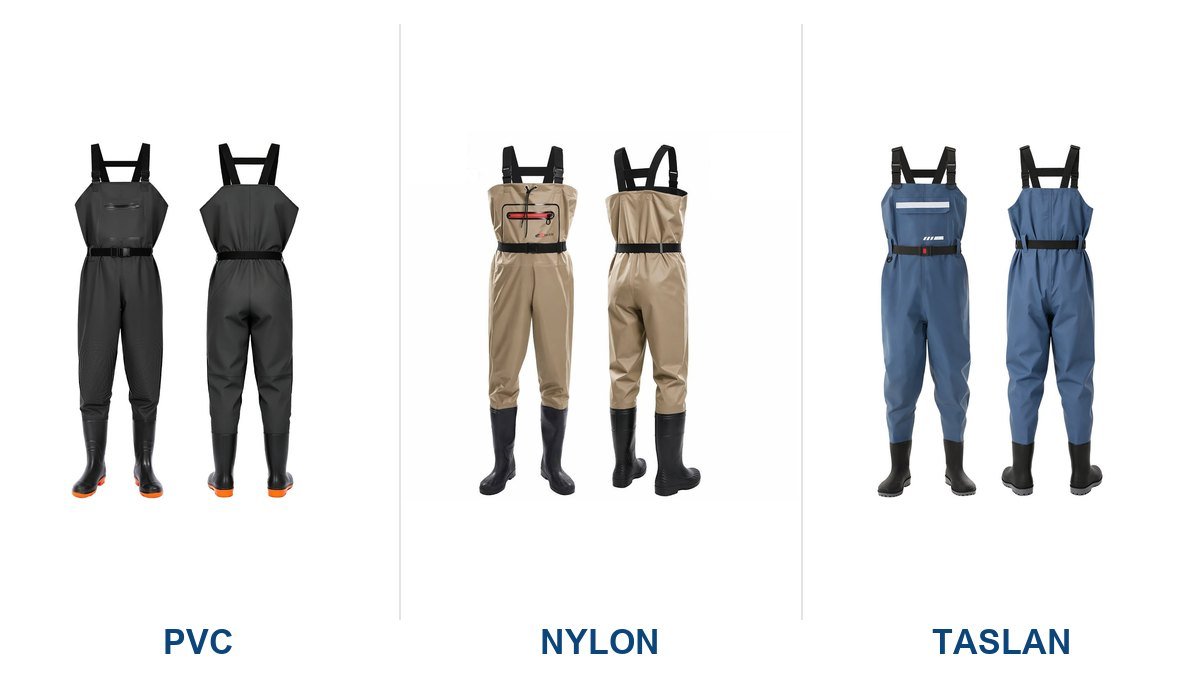
Choosing between PVC vs nylon waders comes down to one question: what will your customers actually do in them? PVC wins on price and total waterproofing, nylon is lighter and more comfortable for long wear, and Taslan — an air-texturized nylon — adds abrasion resistance and a softer fabric feel. We have manufactured all three materials at our Hebei factory since 2007, and this guide compares them from a manufacturer’s point of view: real production specs, MOQ, and which material fits which market.
What Are PVC Waders?
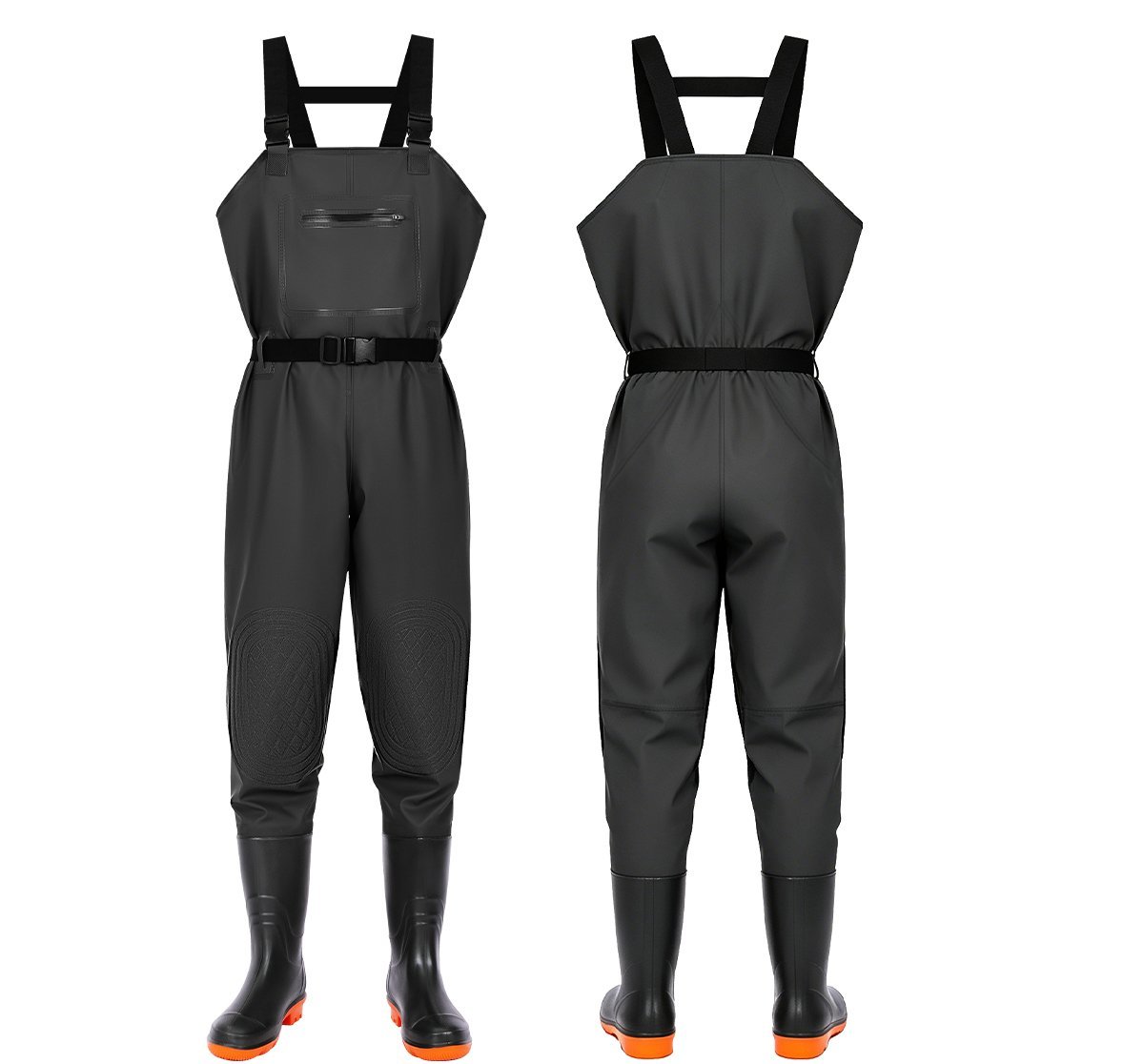
PVC waders are made from polyvinyl chloride film supported by a base fabric. Because PVC itself is impermeable, a finished pair is 100% waterproof — not just the fabric, but every seam. Our seams are closed by high-frequency heat welding, so there is no stitching for water to seep through.
Two production facts matter to buyers:
- Thickness is adjustable. We run adult PVC at 0.45–0.8 mm and kids’ models at 0.35 mm. Heavier film means longer service life on abrasive ground; lighter film cuts cost and weight.
- Boots are injection-molded in-house, so the boot, the weld and the film come from one production line — fewer failure points and stable quality between batches.
What Are Nylon Waders?
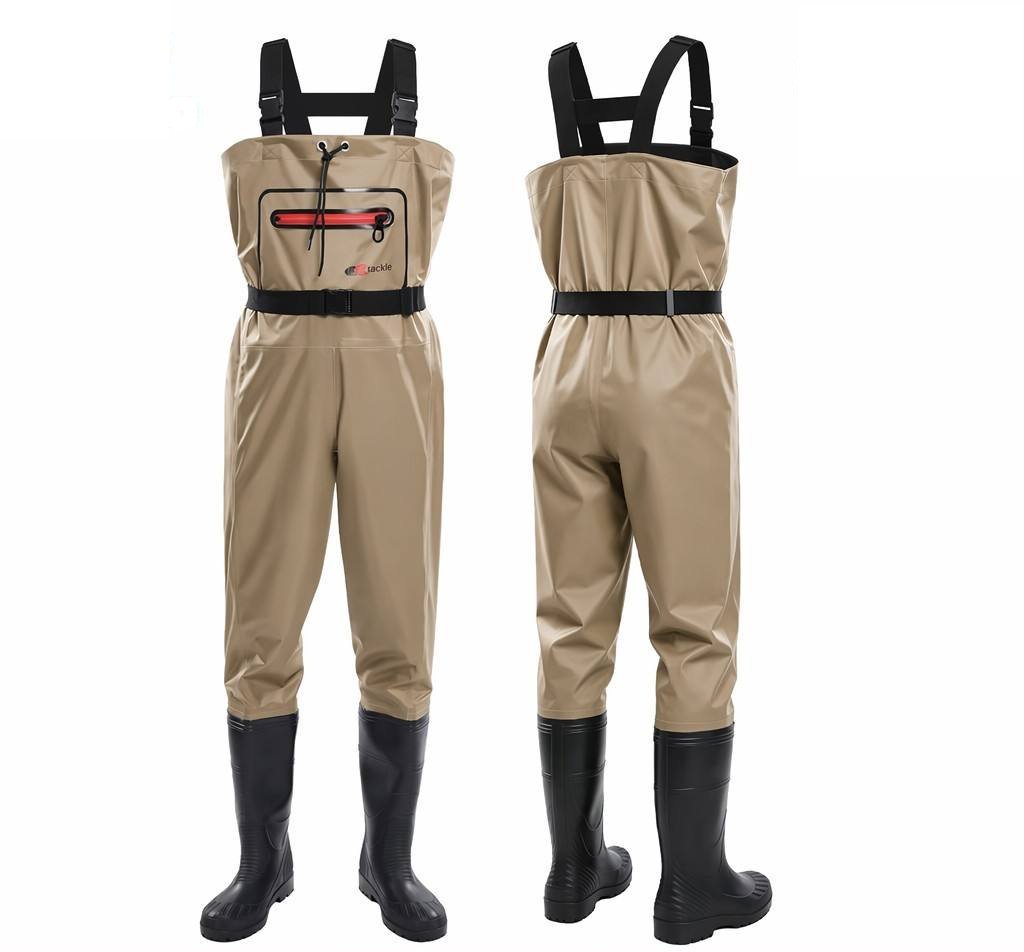
Nylon waders use a woven nylon shell with a waterproof coating (PU or PVC). The result is a noticeably lighter and softer garment that folds down small — the reason nylon is the usual choice for fishing retail programs and long days on the water.
The trade-off: waterproofing lives in the coating rather than the film, so coating quality and seam sealing decide everything. Our nylon models use the same heat-welded seam process, and coated nylon has no specified film thickness — weight and coating quality are the specs to compare between suppliers.
Where weight is the deciding factor, our lightweight nylon chest waders are the model to compare: an airtight zipper pocket, two boot options and EU 36–46.
Where Does Taslan Fit?
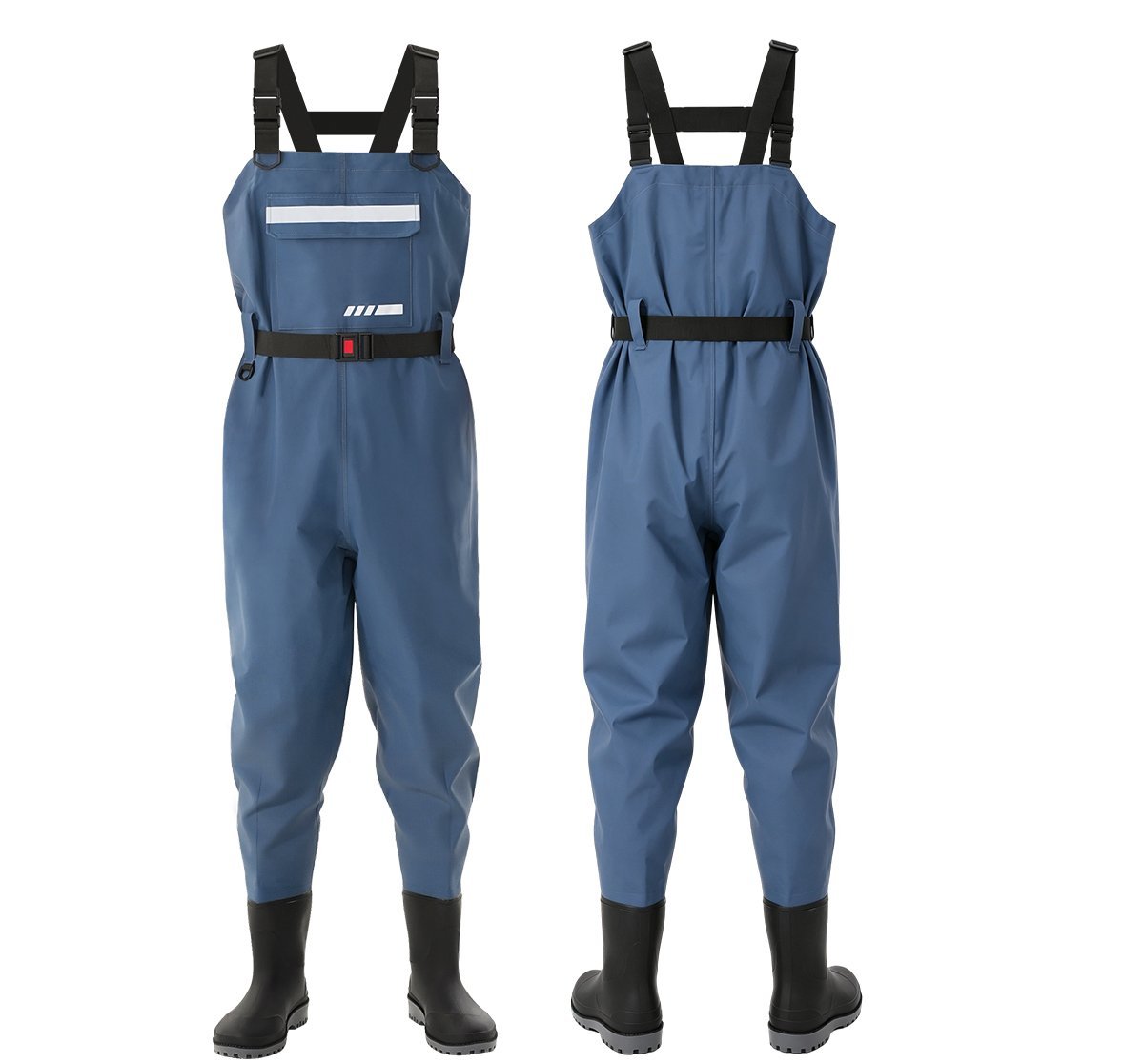
Taslan is not a third material family — it is nylon processed differently. The yarn is air-texturized, which gives the fabric a matte, cotton-like feel, higher abrasion resistance and lower noise than standard smooth nylon. Treated with a DWR finish, it shrugs off light water while staying breathable by woven construction.
For waders, we use Taslan in two lines: a men’s chest model with breathable mesh lining and YKK-buckle belt, and a kids’ line where low weight matters most. Our newest addition is a lighter build in the same Taslan nylon — the lightweight waterproof chest waders with YKK quick-release buckles. If your market is outdoor brands or family products, Taslan is the material that reads “apparel quality” on the shelf. All three chest styles share their fabric with our taslan waist waders, a waist-height cut for shallow water and farm work.
Neoprene vs PVC: Where Neoprene Fits
Buyers comparing PVC vs neoprene waders are usually asking one question: is the extra money buying warmth, or just weight? Neoprene is a closed-cell foam, 3 to 5 mm in most waders, so it traps a film of water against the skin and holds body heat. PVC is a plastic film laminated to a base fabric: it stops water completely, and insulates nothing.
| Property | Neoprene | PVC |
|---|---|---|
| Warmth | High, works in cold water without a lining | None on its own; needs a fleece lining for cold use |
| Weight and pack size | Heavy and bulky at 3-5 mm | Lighter garment, folds down small |
| Flexibility | Stretches in every direction, moves with the body | Stiffer, but takes a wide pattern well |
| Field repair | Needs neoprene cement and time, awkward on site | Glue and patch, five minutes |
| Unit cost | Highest of the wader materials | Lowest at an equal duty class |
| Best for | Cold-water fishing, winter wading, waterfowl hunting | Work sites, warm climates, volume retail programmes |
The trade-off in one sentence: neoprene buys warmth with weight and money, PVC buys service life and margin with no insulation. If a customer stands in cold water for hours and barely moves, neoprene earns its price, and we tell buyers so. If they walk banks, climb in and out of boats, work in mud, or sell into a warm climate, thick PVC wins on both landed cost and repair cost.
Cold markets that still want PVC usually solve it with a lining rather than a thicker film. Our fleece-lined camo hip waders pair a 0.8 mm shell with a fleece lining, which covers most winter fishing at a fraction of neoprene cost.
If a neoprene sample lands on your desk, check three things before comparing it to a PVC quote: the foam thickness in mm, the lining type (nylon jersey or fleece), and whether the seams are blind-stitched and glued or simply stitched. Seam construction is where cheap neoprene fails first.
PVC vs Nylon vs Taslan: Comparison Table
| Property | PVC | Nylon (coated) | Taslan |
|---|---|---|---|
| Waterproofing | 100% (film + welded seams) | Depends on coating + sealed seams | Water-repellent (DWR) + sealed seams |
| Weight & feel | Heaviest, stiff | Light, smooth | Lightest feel, soft matte touch |
| Abrasion resistance | Good, scales with thickness | Moderate | Best among the three |
| Breathability | None | Low | Low–moderate (mesh-lined models) |
| Our thickness spec | 0.45–0.8 mm adult / 0.35 mm kids | No film thickness | No film thickness |
| Best for | Farming, aquaculture, construction, budget retail | Fishing programs, long wear | Kids, outdoor & apparel-grade brands |
| MOQ at Kwavel | 10 pcs regular models (5 pcs fullbody) · 60 pcs fully custom · mixable | ||
Which Material Fits Which Market?
From orders we ship, the pattern is consistent:
- Agriculture, aquaculture and construction distributors reorder PVC. Buyers care about service life and landed cost, and PVC at 0.65–0.8 mm survives mud, gravel and repeated washing. These are also our bestsellers with South American distributors.
- Fishing tackle retailers stock nylon. Customers wear them for hours, so weight and comfort sell the product even if the price per unit is higher.
- Kids’ and outdoor brands choose Taslan. It is the lightest to wear, prints and photographs well, and supports “apparel-grade” positioning.
What Makes a Wader Fabric Heavy Duty?
“Heavy duty” is a marketing phrase, not a standard. No test report defines it and no certification issues it. That is exactly why it is worth knowing the four numbers that actually decide how long a pair of waders lasts, because those four are what a supplier can prove or cannot.
1. Film thickness, quoted per colour. Our adult PVC runs 0.45 mm to 0.80 mm and kids’ film is 0.35 mm. Thickness often varies by colour on the same pattern, because a khaki film and a black film may come off different lines: our double-knee chest waders are 0.45 mm in black, olive and blue, and 0.65 mm heavy duty in khaki. Ask for thickness by colour, never by model name.
2. Base fabric weight. PVC film has no strength of its own; it is laminated to a knitted or woven base, and that base is quoted in g/m². Same film on a heavier base is slower to tear at the knee and crotch. Get the figure in writing. A supplier quoting only “high quality PVC” is quoting a feeling.
3. Plasticiser quality. This is the number nobody asks for. Plasticiser is what keeps PVC flexible, and cheap plasticiser migrates out over a season or two: the wader stiffens, then cracks along the knee fold in cold weather. A well-plasticised 0.45 mm film can outlast a brittle 0.65 mm one. Thickness is the fastest proxy for durability, not a guarantee of it.
4. Seam weld strength. Heat welding removes the stitch holes that leak, which is why every seam on our waders is high-frequency welded rather than sewn. A correct weld is stronger than the film around it. Test it yourself: on a sample, try to peel the seam apart. If it separates cleanly along the weld line, the temperature or dwell time was wrong and the whole batch is suspect.
| Duty class | Film thickness | What it survives | Kwavel model |
|---|---|---|---|
| Kids | 0.35 mm | Family and school programmes, light outdoor use | Kids and special fit range |
| Light | 0.45 mm | Warm-climate fishing, light farm work, budget retail | Double-knee chest waders, black / olive / blue |
| Standard | 0.60 mm | General farm and aquaculture, mixed retail ranges | PVC waist waders, khaki |
| Heavy | 0.65 mm | Construction sites, pond cleaning, gravel and shells, guide use | Double-knee chest waders, khaki and women’s chest waders |
| Maximum | 0.80 mm | Industrial cleaning, concrete edges, waterfowl hunting, cold water | Chest waders with injection boots |
If a buyer asks for industrial waders or construction waders by name, they are describing a duty class rather than a separate product: in practice it means a chest wader in 0.65-0.80 mm PVC with reinforced knees and a boot that survives concrete. Our 0.8 mm model is built to that brief. The job-by-job version of this, with hazards, sole choice and layering for cold sites, is in our waders for work guide, and the farming equivalent covering soil and chemical exposure is in the waders for farming guide.
Four questions settle a heavy duty claim in one email: thickness per colour, base fabric weight in g/m², a tensile and hydrostatic test report, and one seam you are allowed to peel. A supplier who can send all four is quoting a spec. A supplier who cannot is quoting a word.
How We Produce All Three
Kwavel is the export brand of a waders factory founded in 2007 in Yutian County, Tangshan, Hebei. Boot injection, high-frequency heat welding and final inspection all run in-house, which is how we hold MOQ at 10 pieces per regular model (5 for fullbody, 60 for fully custom designs, mixable across models) and ship regular bulk orders in about 7 days. Certificates: CE and Chinese national standard test reports — available on request, and factory visits are welcome. All of our waders are bootfoot — the reasons behind that choice, and how it compares with the separate-boot systems anglers use, are explained in our bootfoot vs stockingfoot waders comparison.
Quick Answers
Are PVC waders 100% waterproof?
Yes — when the seams are heat-welded rather than stitched. PVC film itself is impermeable; welded seams remove the only remaining leak path.
Is Taslan better than nylon?
Taslan is a type of nylon. It is more abrasion-resistant, softer and quieter than smooth nylon, but it relies on a DWR finish rather than a welded film, so it suits lighter-duty use.
Which wader material lasts longest?
For heavy ground work, thick PVC (0.65–0.8 mm) gives the longest service life per dollar — our waders for work guide matches thickness to job sites. Taslan resists surface abrasion best, but its water protection depends on the finish. Whatever the material, how it is looked after decides the second half of its life — see our wader repair and care guide.
What is the MOQ for wholesale waders?
At Kwavel: 10 pieces per regular model, 5 for fullbody models, 60 for fully custom designs — and you can mix models to reach the MOQ.
Can I order waders with my own brand?
Yes. Logo, color, design and packaging can all be customized. Sample fees are refunded against the bulk order.
Is PVC or neoprene warmer?
Neoprene. It is a foam, so it holds a layer of water and insulates; PVC has no thermal value of its own. For cold water we add a fleece lining rather than a thicker film, because a thicker film adds weight without adding warmth.
What thickness counts as heavy duty PVC?
From 0.65 mm upward, provided the plasticiser is good and the base fabric carries it. At 0.80 mm the film stands up to concrete edges, shells and gravel. Below 0.60 mm, “heavy duty” is a claim rather than a specification.
How do I check a wader fabric before placing an order?
Ask for thickness per colour, base fabric weight in g/m², a tensile and hydrostatic test report, and a seam sample to peel. Then wear-test one pair in the real job for two weeks. No quotation sheet replaces that.
Ready to compare samples? Browse our chest waders, waist waders and fullbody waders, or contact us for a material recommendation for your market.