

Wader repair almost always comes down to one place: the seam. A pinhole along a stitch line, or a weld scraped open on a rock, is what turns a dry day into a wet one. This guide covers how to find and fix leaks at seams on PVC and nylon waders, how to wash and store them so they last longer, what decides how long a pair of work waders lasts, and the questions buyers should ask a supplier before ordering.
Kwavel is a waders and rainwear manufacturer in Hebei, China, producing both PVC and nylon models since 2007 for wholesale buyers across South America, Europe and Southeast Asia. The care and repair notes below come from our own factory floor and from after-sales repairs — not from a generic checklist.
1. How Long Do Waders Last?
How long waders last depends far less on the brand than on four things: the material and thickness, the ground you work on, UV exposure, and how you store them between seasons.
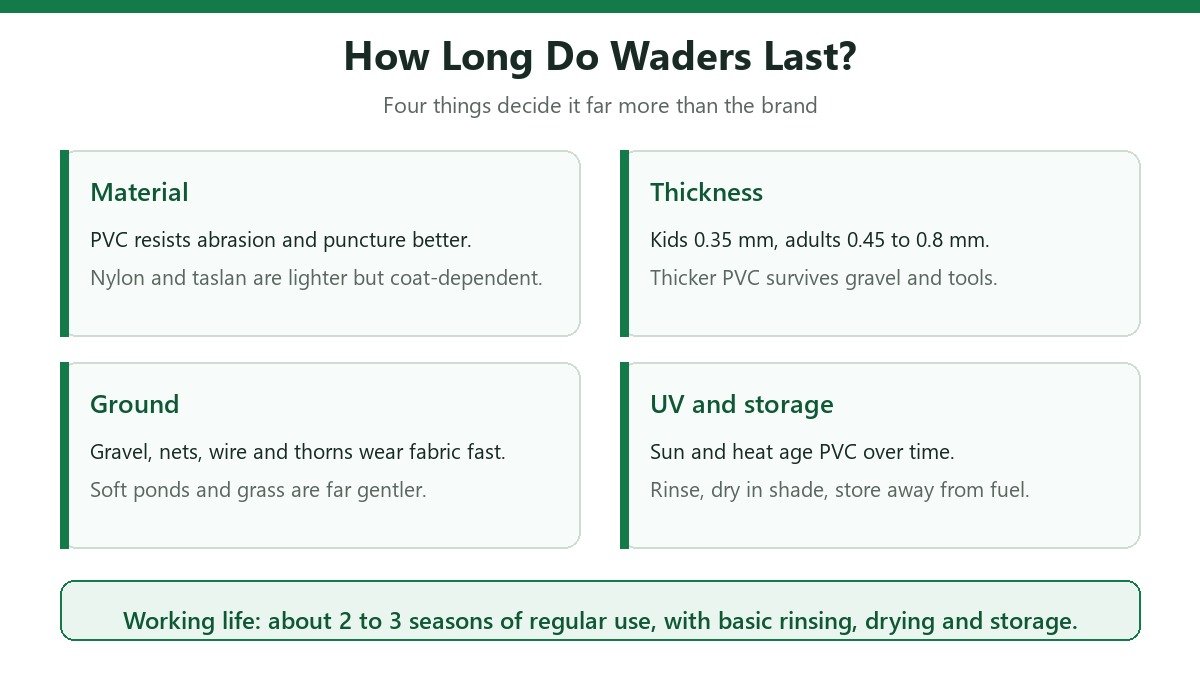
- Material — PVC resists abrasion and puncture better and shrugs off mud, fertiliser and oil; nylon and taslan are lighter and more packable, but rely on their coating, which is the first thing a scuff wears through. See PVC vs nylon waders for the full comparison.
- Thickness — the single biggest dial on durability. Kids’ models run 0.35 mm, adult work waders run 0.45–0.8 mm. Thicker PVC survives gravel, tools and fence lines; thinner PVC bends and walks better.
- Ground — kneeling in gravel, dragging nets, or brushing against wire and thorns wears a leg through far faster than soft pond banks and grass.
- UV and storage — strong sunlight and heat age PVC over time. Rinsed after use and stored out of the sun, a pair lasts noticeably longer than one left dirty in a hot truck.
We do not put a fixed number on it. Two identical waders can have very different lives: rinsed, dried and stored well, a work wader stays watertight far longer; dragged through gravel and left dirty in a hot truck, the same model may not see a second season. The four factors above decide it — which is why the useful question is not how long a wader lasts, but how well it is built and how well it is kept.
2. Where Waders Actually Leak
Look at the pairs that come back for repair and the same three places cause almost every leak:
- Seams and stitch lines — the number-one culprit. Every needle hole is a small gap through waterproof fabric, and flexing at the crotch and knee widens it season by season.
- The boot-to-leg join — a high-flex, high-abrasion point where mud and grit collect and work away at the seal.
- Punctures and scuffs — thorns, barbed wire, nails, exposed rebar and general abrasion against rough ground.
This is why how a wader is built matters more than how it looks. A heat-welded seam fuses the panels into one continuous piece of material with no needle holes, so it stays watertight at every joint for the life of the product. It is how every wader we make is assembled — and the single most useful question to ask any supplier.
3. How to Repair a Leak at the Seam
Repairing waders leaking at seams is a short job if you work clean and let the patch cure fully. Skipping the drying step is why home repairs so often fail twice.

- 1. Find the leak. Turn the wader inside out and look for light in a dark room, or fill a leg with water and watch for a drip. A little soapy water brushed on the outside bubbles at the leak. Mark it with chalk.
- 2. Clean and dry. Wipe the area with isopropyl alcohol, roughen it lightly with fine sandpaper, then let it dry completely. Any moisture or oil under the patch and it will peel.
- 3. Patch it. Use a patch and cement suited to the fabric (see the next section). Cut the patch larger than the damage, coat both surfaces, wait until the cement turns tacky, press the patch on and roll out any air bubbles.
- 4. Press and cure. Weight or clamp the patch and leave it 24 hours before wearing. That full day of curing is what makes a field repair hold.
One caveat: a factory weld is stronger than any repair. If a seam itself has failed, patch over it — do not re-stitch, which only adds new needle holes.
4. Repairing PVC vs Nylon Waders
The fabric decides the patch and the adhesive, so match them:
- PVC waders repair with a PVC patch and PVC cement. Clean, roughen, cement both surfaces, press and cure. A kit with glue and patch material is what you want within reach.
- Nylon and taslan waders repair with a self-adhesive repair tape or a heat-applied patch, because it is the coating — not the fabric — that seals. Press firmly from the centre outwards to avoid trapped air.
Most small leaks never get the chance to grow if they are caught early. A glue and patch repair set can be supplied with every model we make, so your customers have the right materials in the box.
5. Wader Care: Wash, Dry and Store
- Rinse after every use. Fresh water removes salt, mud and fertiliser before they work into the seams and coating.
- Wash by hand, gently. Mild soap and a soft brush only — never a washing machine or dryer, which wrecks seams and coating.
- Dry in the shade. Hang by the boots, never the shoulder straps, and turn the wader inside out to dry the lining. Direct sun hardens PVC over time.
- Store away from heat and chemicals. Hang or fold loosely, and keep fuel, oil, solvents and sharp tools away from the fabric.
- Re-tape small damage early. A five-minute patch now beats a soaked shift later.
6. What Buyers Should Ask a Supplier
- Are the seams welded or stitched? Welded seams are the difference between watertight and not.
- Which material and thickness for my market? PVC for abrasion resistance and low cost; nylon or taslan for light, packable products.
- Is a repair kit available? Glue and patch material save your customers a bad review — every model we make can be supplied with a repair kit.
- Sample, MOQ and mixing. Our MOQ is 10 pieces (5 for full-body suits), sizes and models can be mixed in one order, and the sample fee is credited back on the bulk order.
- Certification and factory access. CE and national standard compliance, from a factory that welcomes visits — ours has run since 2007 in Hebei, China.
- Lead time and payment. Regular models in about 3 days, bulk orders around 7 days; T/T 30/70, L/C or Alibaba trade assurance.
Frequently Asked Questions
How long do waders last?
A well cared for PVC work wader stays watertight far longer than the same model that is never rinsed and left in the sun. There is no fixed figure — thickness, ground abrasion, UV and storage are what decide it, and catching a small leak early is what keeps a pair in service.
Can a leaking wader be repaired, or should I replace it?
Small seam leaks and punctures can be repaired at home with a patch and cement and will hold. If the coating is worn thin across large areas, or the fabric has cracked, replace the wader.
How do I find a leak in my waders?
Turn the wader inside out in a dark room and shine a light inside, or fill a leg with water and watch for drips. Soapy water brushed on the outside bubbles at the leak.
How should I store waders between seasons?
Clean and dry them fully, then hang them by the boots or fold them loosely in a cool, dry place away from sunlight, heat, fuel and oil.
Do your waders come with a repair kit?
Yes. A glue and patch repair set can be supplied with any of our models — just tell us if your market expects one in the box.
Keep Your Crew Dry
Matching waders to the job is what makes them last. Read our guide to choosing waders for work for job-by-job picks, our waders for farming guide for thickness, boot and sizing decisions, then browse the ranges: chest waders, waist waders and fullbody waders. Models crews keep coming back to include the light PVC waist waders, the PVC hip waders for quick shallow work, the PVC bib pants for land-and-water jobs, the double-knee chest waders for crews who kneel on hard ground, the reflective-pocket chest waders for roadside and low-light sites, the heavy duty PVC rain overalls, and the lightweight taslan chest waders for hot climates. Still choosing between the two shallow heights? Our hip waders vs chest waders comparison covers depth limits and sizing for both. Need boots instead? See our waterproof fishing boots.
Message us on WhatsApp at +86 188 3050 5126 or use the contact form — tell us the material, thickness and sizes your market buys, and we will quote within 24 hours.