
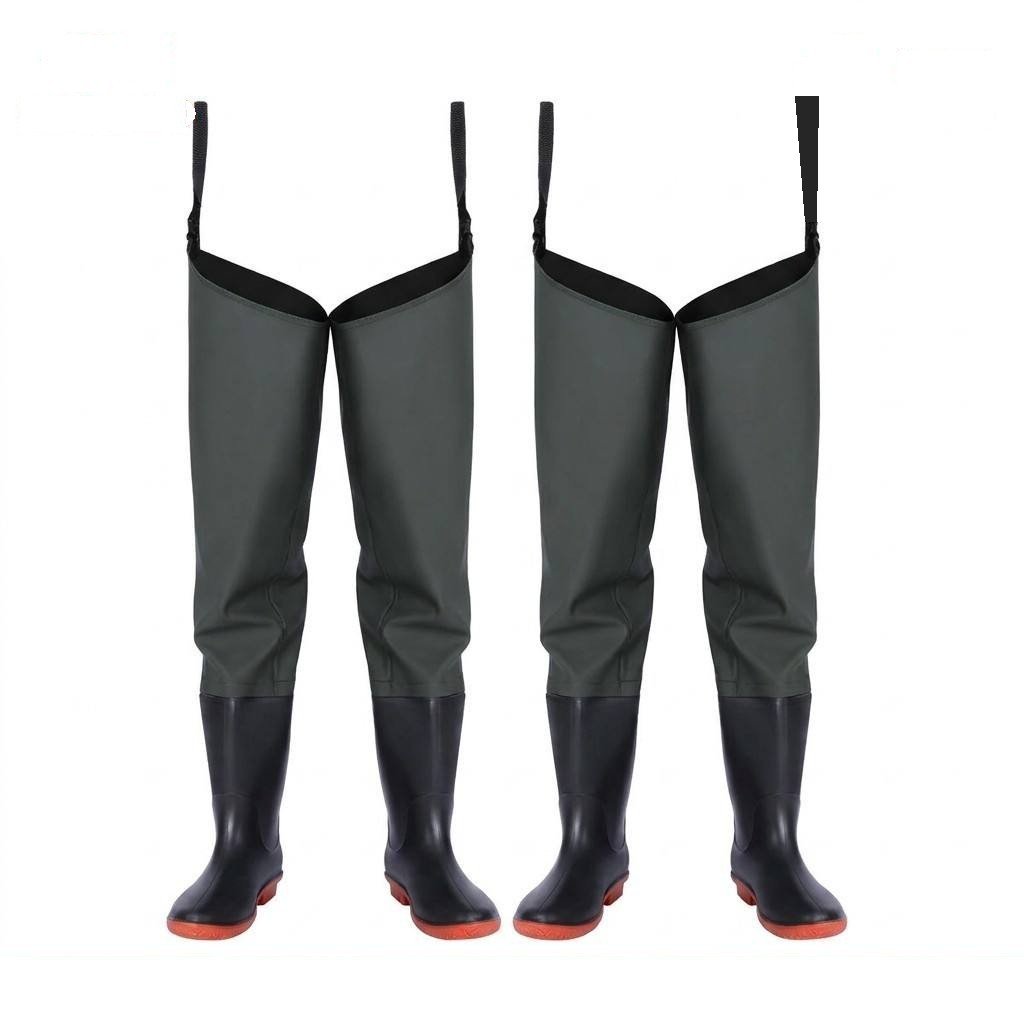
Hip waders vs chest waders is not a choice between two versions of the same product — it is a choice about how deep the wearer will stand, and how much water they can afford to get wrong. The designs share materials, seams and boots. They differ in one dimension: how far up the body the waterproof shell reaches. Everything else — what the wearer can do, how long they can stay in, what happens when they step into a hole — follows from that one dimension.
This comparison is written from the production side. Kwavel makes all three coverage heights in PVC — hip, waist and chest — all heat-welded, all as bootfoot waders, and we ship them to the same distributors. What follows is the honest split, including the depth at which a hip wader stops being a wader and starts being a liability.
1. First, Separate Three Terms That Get Mixed Up
Before the comparison, the vocabulary has to be fixed, because it causes more wrong orders than any other factor in this category. There are three coverage heights, and they are three different garments — not three names for one.
- Hip waders (also called hip boots or thigh waders) come up to the top of the thigh. They are two separate legs, one per leg, held up by straps that clip onto the wearer’s belt. Safe water: knee to upper-thigh depth.
- Waist waders (waist-high waders, also called wading pants) are a one-piece trouser that reaches the natural waist, held by an elastic waist belt or belt loops. Safe water: mid-thigh depth.
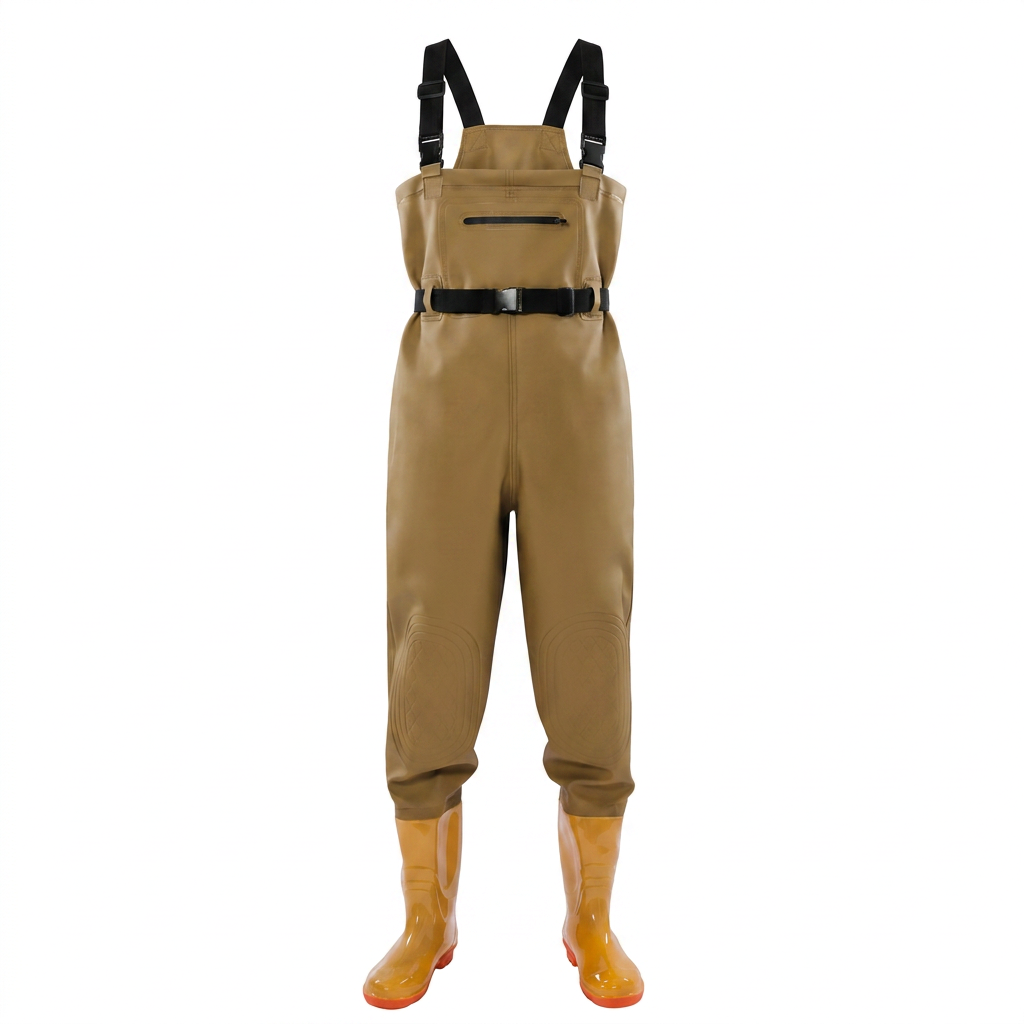
- Chest waders reach the chest and are held up by shoulder straps, usually with a waist belt over them. Safe water: standing water up to the lower ribcage.
The mix-up is real, and it is not just buyers: catalogues and online listings frequently label a waist-high wader as “hip waders” because the word is searched more. A buyer who orders thigh-height boots expecting a joined trouser — or the reverse — has a return on their hands. The reliable check is not the name, it is the construction:
- Two separate legs with hanging straps = a hip wader.
- Joined trousers with a waistband = a waist wader.
- Shoulder straps = a chest wader.
Kwavel builds both of the shorter types, and the difference shows clearly in our own line: our PVC hip waders (model HW-PM-A) are two separate legs with quick-release buckle straps, while our PVC waist waders (model WAW-PM-A) are a joined trouser with an elastic waist belt and a waterproof zip pocket. Same factory, same seams, two different garments.
2. The One Difference That Decides Everything: Water Depth
Height of the shell is a hard limit on the depth of water the wearer can stand in. It is not a comfort preference; it is the point at which the garment stops working.
- Hip waders are safe to the top of the thigh. Below that is fine; at the top edge is the limit. One step deeper, and water goes over the top.
- Waist waders buy roughly a hand’s width more — enough to matter on uneven ground, but still no reserve for a wave or a slip.
- Chest waders are safe to the bottom of the ribcage. That converts to thigh-deep to waist-deep water depending on the wearer’s height, and it buys margin — a foot of margin is the difference between a wet shirt and a soaked one.
- Standing water is not the only variable. A boat wake, a fish thrashing at the net, or a colleague walking past at speed all raise the water level around the wearer for a second. That second is what a hip wader has no reserve for.
Everything in the next four sections is a consequence of this.
3. Hip Waders: Where They Win
What you gain
- On and off in under a minute. Two legs, straps clipped to a belt, nothing goes over the head. For work that involves repeatedly leaving the water — unloading at a pond edge, moving between tanks, pressure washing, launching boats — this is the whole argument.
- Free upper body and free stride. Nothing joins the legs at the top, so walking, climbing banks and kneeling are unrestricted in a way no trouser-style wader matches.
- Cooler in warm weather. The smallest coverage of any wader type. On a summer fish farm or in a warm-climate shrimp pond, a chest wader is genuinely uncomfortable by mid-morning.
- Less material, less cost, less bulk. Fewer square metres of coated fabric per unit and a smaller carton. That shows up in unit price, in freight and in warehouse space.
- Easiest to size for a mixed crew. The leg and the boot do most of the fitting; there is no waist girth and no chest girth to get wrong. Our hip model runs EU 36/37 to 45/46/47, and the quick-release straps absorb the rest of the variation between wearers.
What you give up
- No margin for depth. This is the one that matters. A hip wader has roughly zero reserve above the waterline it was bought for.
- Nothing above the thigh stays dry. Rain, spray and splashes run straight onto clothing. In a chest wader the same splash lands on the shell.
- Cold water is a different garment. Insulation is a function of how much of the body is covered. Our camo fleece-lined hip model (0.8 mm) exists for autumn and winter use, but a hip wader is still leg coverage, not cold-water equipment.
- Pockets and tools go on a belt. Small, but crews notice.
4. Chest Waders: Where They Win
What you gain
- Depth, and the margin above it. The reason chest waders exist. For river work, deep ponds, flood cleanup and any situation where the bottom is not fully known, the height is the safety equipment.
- Warmth. More coverage, more trapped air, and room for a lining. The fleece-lined option in our range exists for exactly this reason, and the same logic applies across heights.
- Dry upper body in bad weather. Rain gear becomes optional rather than essential.
- Carrying capacity. Chest pockets, handwarmer pockets and a place to put things that does not hang off a belt. Our PVC chest waders with injection boots carry a front pocket with a waterproof zipper, double-layer reinforced knees and adjustable suspenders — the model most industrial buyers start with.
- Better resale perception. In most markets a chest wader reads as “proper” equipment and a hip wader reads as a budget option, regardless of build quality.
What you give up
- Slower to put on and take off. Straps, and a garment that has to come off almost completely for a bathroom break. For an eight-hour shift in and out of the water, this is a real cost.
- Hot. The same coverage that keeps a wearer warm in March makes them miserable in August.
- More sizing variables. Body height and chest girth join boot size. Get the height wrong and the crotch seam sits in the wrong place, and that is a comfort complaint no amount of strap adjustment fixes.
- More material per unit. Higher unit cost, bigger carton.
5. Hip Waders vs Chest Waders — and the Waist Wader Between Them: Side by Side
So the honest comparison is not only hip waders vs chest waders. The waist wader takes its own column, and putting all three side by side is where the buying logic becomes obvious:
| Criterion | Hip waders | Waist waders | Chest waders |
|---|---|---|---|
| Reaches | Top of the thigh | Natural waist | Lower chest |
| Construction | Two separate legs | Joined trouser | Bib with shoulder straps |
| Held up by | Straps clipped to a belt | Elastic waist belt | Suspenders + waist belt |
| Safe water depth | Knee to upper thigh | Mid-thigh | To the chest, with margin |
| Time to put on | Fastest | Fast | Slowest |
| Warm weather comfort | Best | Good | Poor without breaks |
| Cold water comfort | Limited | Limited | Best, and can be lined |
| Upper body in rain | Wet | Wet | Dry |
| Sizing variables | Boot + leg | Boot + waist | Boot + height + chest |
| Material per unit | Least | Less | Most |
| Typical use | Pond edges, boat ramps, washing, shallow farm work | Bank fishing, aquaculture, car washing, flood cleanup on flat ground | Rivers, deep ponds, winter work, anything from a boat |
6. The Middle Option: Waist Waders Deserve Their Own Line
Between the two ends sits the garment most buyers actually picture when they say “hip waders” — the waist wader, or wading pant. It is a joined waterproof trouser with a wide elastic waist belt, and it earns its place in a distributor’s range for one reason: it covers the water depth that sits just past what a hip wader can safely handle, without the cost, weight and heat of a chest bib.
On our line, the PVC waist waders with belt and boots (model WAW-PM-A) add three things a hip wader structurally cannot have: a waterproof zip pocket at the hip, a 3D ergonomic cut so the seat and knees move with the wearer, and a closed waist opening that sheds splash instead of letting it run down inside the boot. The trade-off versus hip waders is small but real: slightly slower to take off, slightly more material per unit, and a waist measurement that needs to fit.
The same construction scales across the rest of the waist range, and none of these need a chest girth measurement: our women’s waist waders keep the joined trouser shape on a women’s pattern with a breathable mesh waist, our plus size waist waders grade the same pattern up on an elastic drawstring waist, and the camo waist waders cover crews that want colour choice in 0.45 to 0.8 mm. If the honest answer for a buyer is “a waist wader, in this size, for this job”, there is usually a model for it.
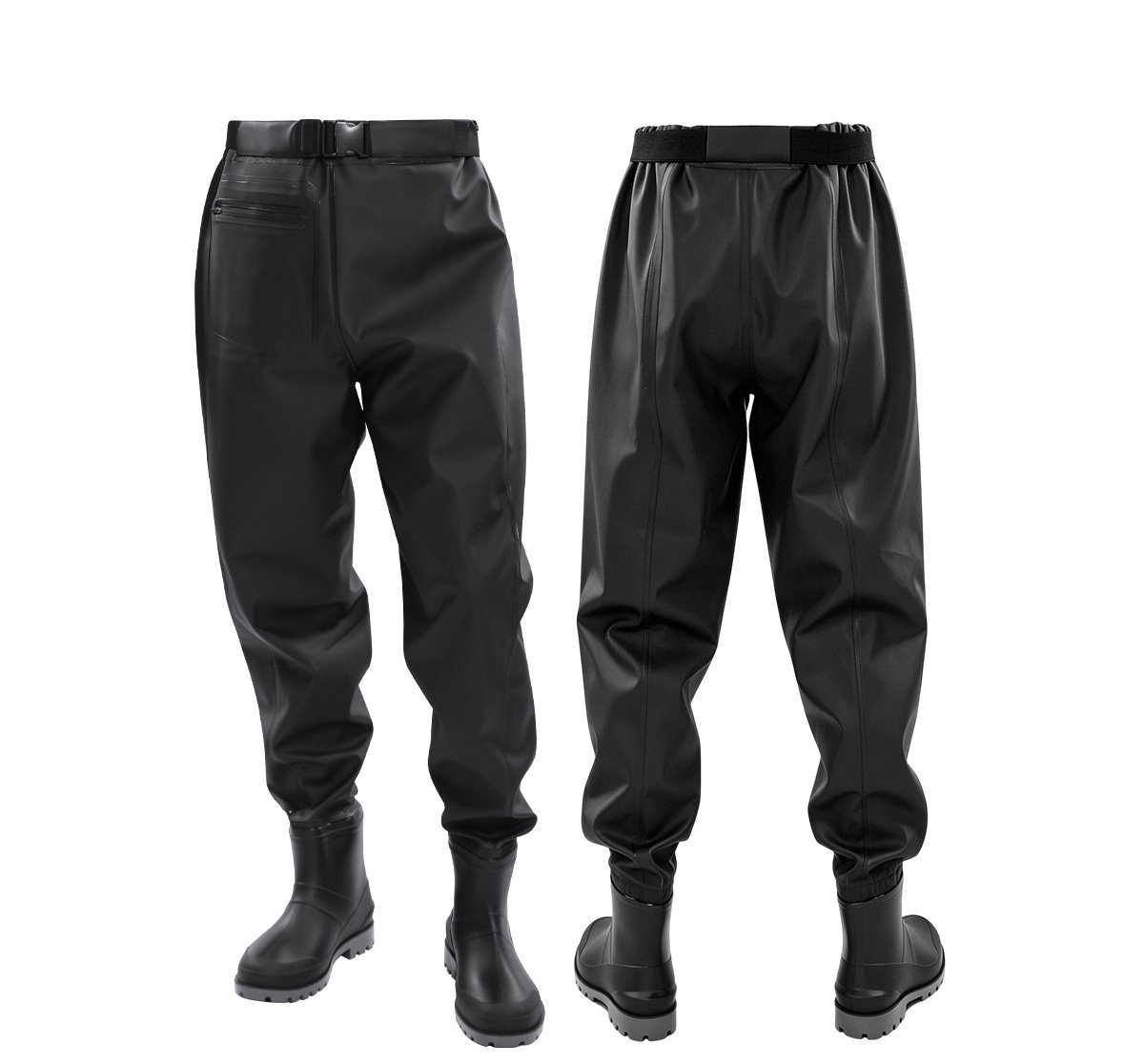
For a crew that works mid-thigh water all day — aquaculture ponds, car-wash bays, flat-ground flood cleanup — this is usually the right default, with chest waders kept for the deep spots.
7. The Safety Line Nobody Should Cross
A hip wader is not a cheaper chest wader. It is a garment with a hard depth limit, and the failure mode is not gradual: the water goes over the top, the legs fill, and the wearer is suddenly carrying two buckets of water while standing in a current.
Three situations should always get a chest wader, regardless of budget:
- Any moving water with an unknown bottom. A step into a hole does not need to be deep to put a hip wader under water.
- Any work from a boat or a floating platform. The wearer is not standing on the bottom, and a fall is not recoverable in a filled wader.
- Cold water at any depth. Cold shock is not a comfort issue, and coverage is the only insulation a PVC shell provides.
If a crew is issued hip waders for these, the saving on unit cost is paid for once. The practical answer for most operations is not one or the other — it is chest waders for the people who go deep and hip or waist waders for the people who do not, chosen per task rather than per budget.
8. Fit and Sizing: Three Designs, Three Sets of Numbers
All three designs in our range are bootfoot, so the boot size is the anchor in every case. What changes is what else has to be measured.
- Hip waders need boot size and leg length only. The quick-release buckle straps take care of the rest, which is why one size band fits a wide range of builds.
- Waist waders need boot size and a waist fit. The wide elastic belt absorbs most variation, but the seat and hip cut should match the wearer — that is what the 3D cut on our model is for.
- Chest waders additionally need body height and chest girth. The crotch seam has to sit where the wearer’s crotch is; too tall a size and it hangs, too short and it pulls.
- Size bands overlap but are not identical. Our hip model runs EU 36/37 to 45/46/47, the waist model runs EU 38 to 46 (with 36/37 and 47 available on custom orders), and the chest range runs 36 to 47. A mixed order is easy to assemble, but check each model’s own table — the full breakdown, including the height and girth rows, is in the wader size conversion chart.
- Extended sizes follow the same logic. Larger builds are served by graded patterns rather than by a bigger label — the reasoning is set out in our plus size waders guide.
The fitting method itself is the same for all three: measure the foot, then fit the body over the clothes the wearer will actually have on. The steps are in how to size waders.
9. What Wearers Actually Complain About
Two years of returns tell you more than a spec sheet.
- Hip wader complaints are almost all depth. “They filled up.” Not a defect — a buying error, and one that a distributor can prevent by asking about the water before quoting.
- Chest wader complaints are almost all fit. Crotch seam in the wrong place, straps digging in, or a body too tall for the size bought. All three are sizing variables, and all three are avoidable with the height row on the size table.
- All heights share the same two failure points: the seam and the sole. A heat-welded seam does not have needle holes to leak through, and every seam on our PVC models is made that way. Soles are the wearing part — the thickened oxford sole on the hip model and the rhino sole on the waist model exist because smooth soles on wet mud are the fastest way to lose a customer. Seam care and repair is covered in the wader repair and care guide.
10. What to Stock if You Are Buying for a Crew
Most operations do not need one answer. They need all three, split by task:
- Shallow, repetitive, warm: hip waders. Pond edges, boat ramps, washing down, hatchery work. Cheapest per unit, fastest to issue, least miserable in heat.
- Mid-depth routine work: waist waders. Bank fishing, aquaculture, car wash bays, flat-ground flood cleanup. The pocket and the closed waist earn their keep on long shifts.
- Deep, cold or unknown: chest waders. Rivers, intake structures, deep ponds, winter work, anything from a boat.
- Ratio: where the water depth is known and shallow, crews typically run mostly hip and waist waders with a few chest pairs for the deep spots. Where the bottom is unknown, invert it.
- MOQ is not the constraint. All designs start at 10 pieces per model and can be mixed inside one order — so a first order can hold hip, waist and chest models together. If you are comparing suppliers rather than models, our waders supplier checklist covers the questions to ask before that first order.
Task-specific selection for the two big application clusters is written up separately: waders for farming and waders for work.
11. Frequently Asked Questions
Are hip waders and waist waders the same thing?
No. A hip wader is two separate legs that reach the top of the thigh and hang from straps on a belt. A waist wader is a joined trouser that reaches the natural waist. Listings that label a waist-high wader as “hip waders” are the main source of wrong orders in this category — check the construction, not the name.
How deep can you go in hip waders?
To the top of the thigh, with no margin. That is the design limit, not a recommendation — water over the top fills the legs. Anything deeper, any moving water, or any work from a boat should be done in chest waders.
Who are waist waders for?
Crews standing in consistent mid-thigh water: aquaculture ponds, car washing, bank fishing, flat-ground flood cleanup. They cover the gap between a hip wader’s limit and the depth where a chest wader starts to make sense, and they stay cooler than a chest bib on long shifts.
Can hip waders be worn in winter?
They can, but they cover the least of the body, so they are the wrong tool for cold water at any depth. If winter work is part of the plan, buy chest waders for those crews. Our fleece-lined camo hip model (0.8 mm) serves cold but shallow work — hunting, late-season farm chores — without pretending to be a chest wader.
Which is cheaper?
Hip waders, then waist waders, then chest waders — the ordering follows material per unit. The gaps are smaller than most buyers expect, though, because the boot — the expensive part — is a shared component across all three.
Do all three come in the same sizes?
They overlap but are not identical: our hip model runs EU 36/37 to 45/46/47, the waist model runs EU 38 to 46, and the chest range runs 36 to 47. Chest waders additionally need a body height and a chest measurement, which is why they have more rows in the size table.
12. Where We Fit
We build all three coverage heights the same way: PVC shell, 100% heat-welded seams, bootfoot construction, CE and national quality test report behind them, and a 10-piece minimum that allows hip, waist and chest models to be mixed in one order. We are also happy to say which one you do not need — quoting a chest wader for a job a hip wader handles is a smaller order, and it is the right one.
Send the water depth, the task and the size range you need. If you are weighing hip waders vs chest waders for a crew rather than for yourself, that is the conversation we have most often — and if the honest answer is a waist wader in between, we will say that too.
Ask the factory directly: WhatsApp +86 188 3050 5126, or use the contact form with depth, quantity and sizes.