
Waders for work are bought differently from fishing waders: nobody chooses them for looks, and a crew leader’s real question is whether the pair is still watertight at the end of a shift, month after month. This guide is for buyers equipping crews — docks and jetties, fish farms, construction and drainage work — and covers how to match thickness, boots and coverage to the job, how to size a workforce, and what to confirm with a supplier before ordering in bulk.
Kwavel is a waders and rainwear manufacturer in Hebei, China, producing PVC and nylon models since 2007 for wholesale buyers across South America, Europe and Southeast Asia. The notes below come from what industrial and aquaculture distributors actually reorder — not from a catalog.
1. What Work Waders Must Survive
Recreational waders are judged on comfort. Work waders are judged on downtime — how often a pair comes back leaking, and what a stopped shift costs. Whether your market calls them industrial waders, heavy duty work waders or waders for working in water, the same four requirements decide it:
- Abrasion resistance — gravel, concrete, tools, fence wire and oyster racks. This is where PVC thickness and material quality show up first.
- Seams that stay tight under constant flexing — crouching, ladder rungs, kneeling. Every stitch in a sewn wader is a needle hole; heat-welded seams fuse the panels into one piece with no hole to leak from.
- A sole that grips wet, slippery ground — algae-covered pond banks, wet concrete, muddy ramp ways.
- Coverage matched to depth and debris — water only reaches the calf on some jobs; on others it is a full-body affair.
2. Match the Wader to the Job
The fastest way to choose is to start from the worksite, not from a product list.
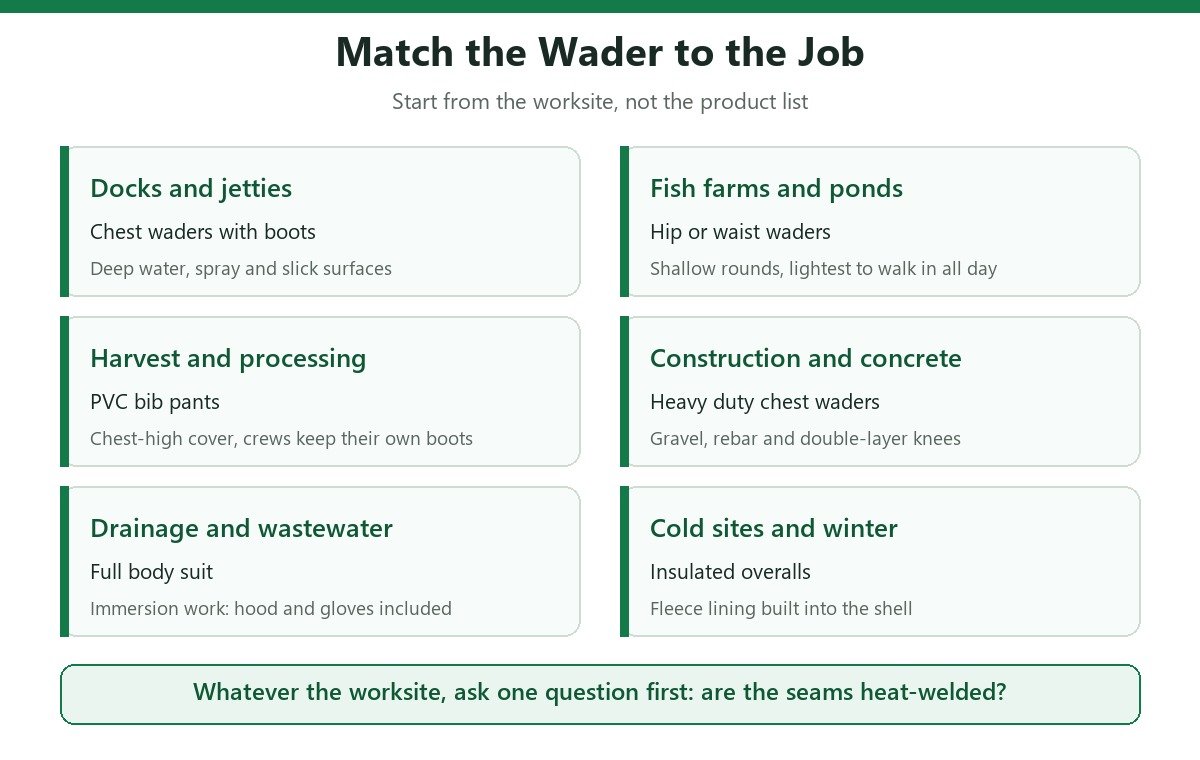
Docks, jetties and shore crews
Water comes up high, surfaces are slick, and crews often work early mornings or next to traffic. A boot-foot chest wader covers the depth and keeps spray out. For crews that work by roadsides or in low light, our PVC chest waders with a reflective pocket add visibility without buying a separate hi-vis layer.
Fish farms and aquaculture
Feeding rounds, pond work and net checks mean hours standing in ponds and raceways, so lightness matters as much as protection. Hip waders suit quick shallow tasks; chest models take the deep nets; and for crews that move between water and processing areas, PVC bib pants keep chest-high coverage while normal work boots stay on the feet. The full picture for pond work is in our waders for farming guide.
Construction and concrete work
Cement slurry, rebar and rubble punish knees and shins first. Heavy PVC at the top of the thickness range plus reinforced knees is what survives — our double-knee chest waders are built for exactly this kind of ground. Where the job sprays water or slurry from above, a waterproof rain suit for work keeps the top half dry.
Drainage, wastewater and cold sites
When the job means being inside the water, not just standing in it, coverage goes full-body: our PVC full body waders with hood and gloves close the whole shell at the face. For cold sites, insulated waders for work beat stacking thicker socks: our waterproof insulated overalls build the warmth into the shell with a fleece lining.
3. Thickness: The Durability Dial
PVC is the modern working alternative to the traditional rubber wader — the same toughness, lighter to walk in, and it welds instead of stitches. Within PVC, film thickness is the single biggest lever on service life, and it is the first number to confirm with any supplier:
- 0.45 mm — light duty and long walking days; bends easiest.
- 0.60 mm — standard work duty: ponds, ramps, daily wash-down.
- 0.65–0.80 mm — heavy duty: gravel, tools, rebar and fence lines; our heavy duty PVC rain overalls run 0.8 mm.
We run adult PVC at 0.45–0.8 mm and kids’ models at 0.35 mm. For how thickness plays out on soft ground and pond banks specifically, see the farming guide — the logic is identical.
4. Boots and Soles for Work Ground
Three checks before you order any boot-foot wader for a crew:
- How the boot attaches. An integrated PVC injection boot welded at the ankle has no stitch line to leak — glued-on boots fail at the glue.
- The sole. A cleated PVC sole grips wet clay and algae-covered stone. If your crews work around nails or sharp debris, ask the supplier about a puncture-resistant midsole before ordering.
- The shaft. Full PVC is easiest to rinse clean; nylon-top boots breathe better in hot climates — for crews that prefer separate footwear, our waterproof fishing boots with a nylon top work alongside bib pants.
5. Chest, Bib Pants, Full Body or Rain Suit?
Coverage is a depth-and-debris decision, not a preference:
- Hip and waist waders — water below the waist; lightest to walk in all day. Belted waist waders stop a flooded leg from filling the whole garment.
- Chest waders — the default for deep water, rain and spray.
- Bib pants — chest-high coverage with ordinary boots, for land-and-water jobs.
- Full body suits — immersion, wastewater, flood response: one continuous shell, hood and gloves included.
- Rain suits and overalls — when the hazard comes from above rather than below.
6. Sizing a Crew and Ordering in Bulk
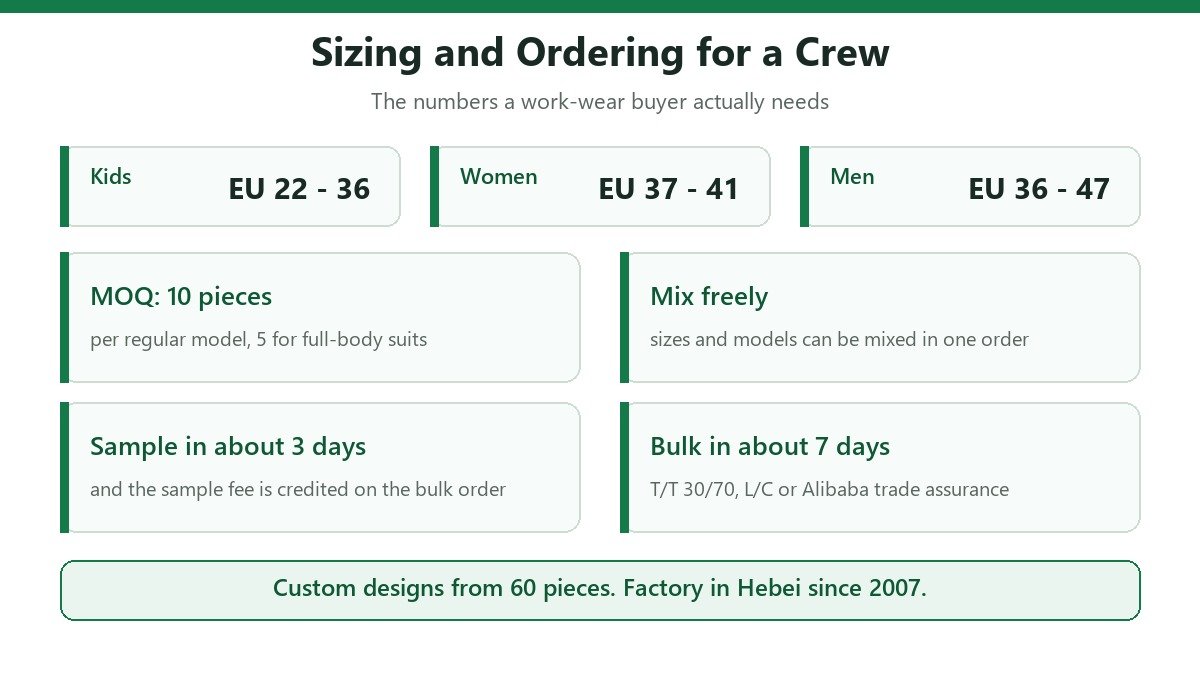
Work waders follow EU shoe sizing: kids 22–36, women 37–41, men 36–47. Size each wearer by height and weight first — the boot size matters less than whether the body fits over work clothes. The matching walkthrough is in our wader sizing guide: measure the foot, convert EU to US or UK, then check garment height. If part of the crew sits outside the standard range, our plus size waders guide covers the extended patterns, which are sized by weight instead of boot size.
For mixed crews, women’s sizes are cut on a women’s pattern rather than a scaled-down men’s one — see our women’s nylon chest waders with pocket (EU 37–41).
For bulk orders, the numbers that matter at Kwavel: MOQ 10 pieces per regular model (5 for full-body suits), and sizes and models can be mixed within one order — a six-person crew does not have to buy six identical pairs. Fully custom designs start at 60 pieces, and the sample fee is credited back on the bulk order. Regular models ship in about 3 days, bulk orders in around 7; payment by T/T 30/70, L/C or Alibaba trade assurance. If you are still shortlisting factories, our waders supplier checklist covers what to ask before the first order.
7. What to Confirm Before You Order
- Welded or stitched seams? The single most useful question — welded seams are the difference between watertight and not.
- Thickness in writing. Ask for the film thickness in mm per model, not “heavy duty”.
- Boot construction. Injection-welded at the ankle, or glued?
- Sizing range. Can the supplier cover your whole crew, including women’s and kids’ sizes, in one order?
- Repair material. A glue-and-patch kit supplied with every model saves your customers a stopped shift — see our wader repair and care guide for what a field repair involves.
- Certification and factory access. CE and Chinese national standard test reports, from a factory that welcomes visits — ours has run since 2007 in Yutian County, Tangshan, Hebei.
Frequently Asked Questions
What are the best waders for working in water?
The ones matched to your depth, ground and debris: chest waders for deep or sprayed work, hip and waist models for shallow rounds, bib pants when crews keep their own boots. Whichever you pick, confirm the seams are heat-welded. If the choice is between a hip and a chest model for the same task, our hip waders vs chest waders comparison sets out the water depth each one is safe to and how the sizing changes between them.
What thickness of PVC do work waders need?
For abrasive ground — gravel, concrete, rebar — 0.65–0.8 mm. For light duty and long walking days, 0.45–0.6 mm is easier to move in.
Can work waders be repaired, or must they be replaced?
Small seam leaks and punctures patch cleanly with the right cement and a 24-hour cure. Replace a wader when the coating is worn through across large areas or the fabric has cracked.
How do I size waders for a whole crew?
Use EU shoe sizing (kids 22–36, women 37–41, men 36–47), fit the body over work clothes first, and order mixed sizes in one batch — our MOQ allows mixing sizes and models.
What is the MOQ for wholesale work waders?
At Kwavel: 10 pieces per regular model, 5 for full-body suits, 60 for fully custom designs — models and sizes mixable within one order.
Keep Your Crew Dry
Start from the worksite, confirm the seams, and order for the whole crew at once. Browse the ranges: chest waders, waist waders, fullbody waders and rainwear. Models crews reorder most for work sites include the waterproof rain suit for work, the heavy duty PVC rain overalls and the full body waders with hood and gloves.
Message us on WhatsApp at +86 188 3050 5126 or use the contact form — tell us the job, depth and sizes your crews need, and we will quote within 24 hours.