
Plus size waders are not standard waders with two extra sizes bolted onto the end of the chart. Past a certain girth the pattern itself has to change: the waist, the thigh opening, the rise and the boot position all move together, and a cut that simply scales up a medium pattern will pull at the crotch and bind across the thigh the moment the wearer kneels. This guide covers the measurements that actually decide whether an extended size fits, the two plus size patterns we build, and the numbers behind them.
Kwavel has produced PVC and nylon waders in Hebei, China since 2007, mainly for wholesale buyers in South America, Europe and Southeast Asia. The measurements below come from our own production charts for extended sizes, not from a generic size conversion table.
1. What Makes a Wader “Plus Size”
A wader has two independent fit systems. The boot is sized like footwear and decides how the feet sit. The garment covers the body from the boot top upward, and on chest waders it also carries the torso. Extended sizes exist because the second system runs out long before the first one does.
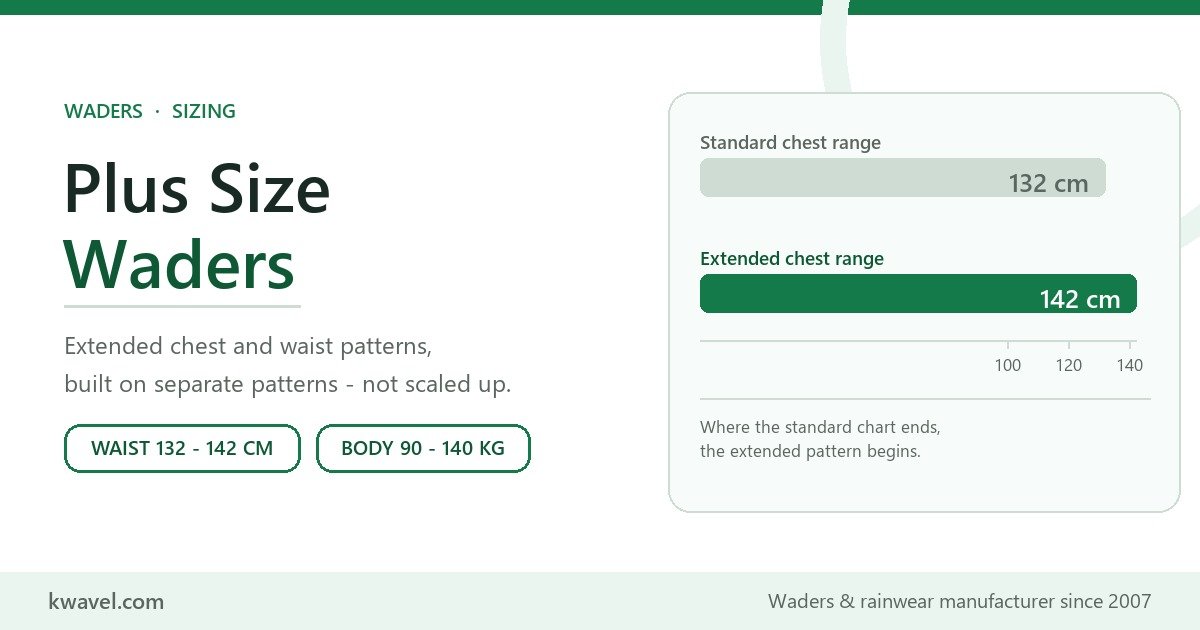
In our standard chest wader range the largest waist measurement is 132 cm, on the 45/46/47 boot size. That covers a large share of adult men, but it stops there — and a buyer who needs 140 cm of waist cannot solve it by taking a bigger boot, because the boot would then be three sizes too long. The size chart becomes a dead end at exactly the point where the customer needs a second option.
Why standard sizes stop at 132 cm
It is a pattern limitation rather than a decision about demand. Standard patterns are graded in steps from a base size, and the grading rules keep the proportions fixed: add 4 cm of waist and the pattern adds a proportional amount of thigh, rise and length. Past a certain point that proportional step stops matching real bodies, and the garment starts fitting like a tent above the waist while still being tight across the thigh.
The three numbers that decide the fit
- Waist — measured at the natural waist, not at the trouser waistband. This is the number that decides whether the garment closes comfortably over winter clothing.
- Thigh circumference — the measurement most buyers never take and the one that causes most plus size returns. A wader can close at the waist and still be impossible to kneel in.
- Height and rise — two people with the same waist can need very different garment lengths, and a chest wader that is short in the rise pulls down on the shoulders all day.
2. How to Measure for Plus Size Waders
Three measurements, taken over the clothing the wader will be worn with, are enough for us to recommend a size without a video call. A tape measure and five minutes per person is all it takes.
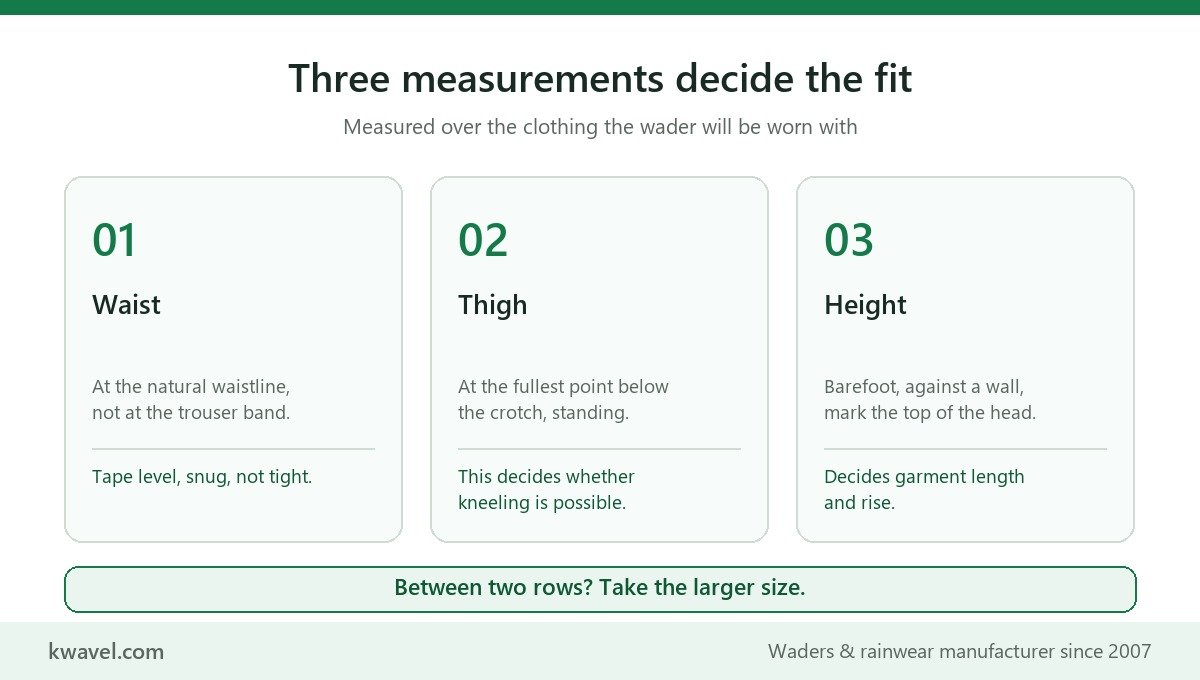
Step 1 — Waist, at the natural waistline
Find the natural waist by bending sideways; the crease that forms is the natural waistline. Measure around it, keeping the tape level and snug but not compressing. Do not measure over a belt, and do not measure at the hip. If the number lands between two rows in the chart, take the larger one — a wader that is slightly loose can be worn, one that is tight cannot.
Step 2 — Thigh circumference, standing
Measure around the fullest part of the upper thigh, just below the crotch. This number is what tells you whether the leg opening will let the wearer kneel, climb into a boat or step over a fence. On our extended chest pattern the thigh opening runs 90 cm and 98 cm across the two sizes — a full 8 cm wider than the largest standard size.
Step 3 — Height, measured barefoot
Stand against a wall without boots and mark the top of the head. Height decides the garment length and, on chest waders, where the chest panel sits. If the height sits at the top of a size’s range, go up one size rather than accepting a short rise.
3. The Plus Size Range We Produce
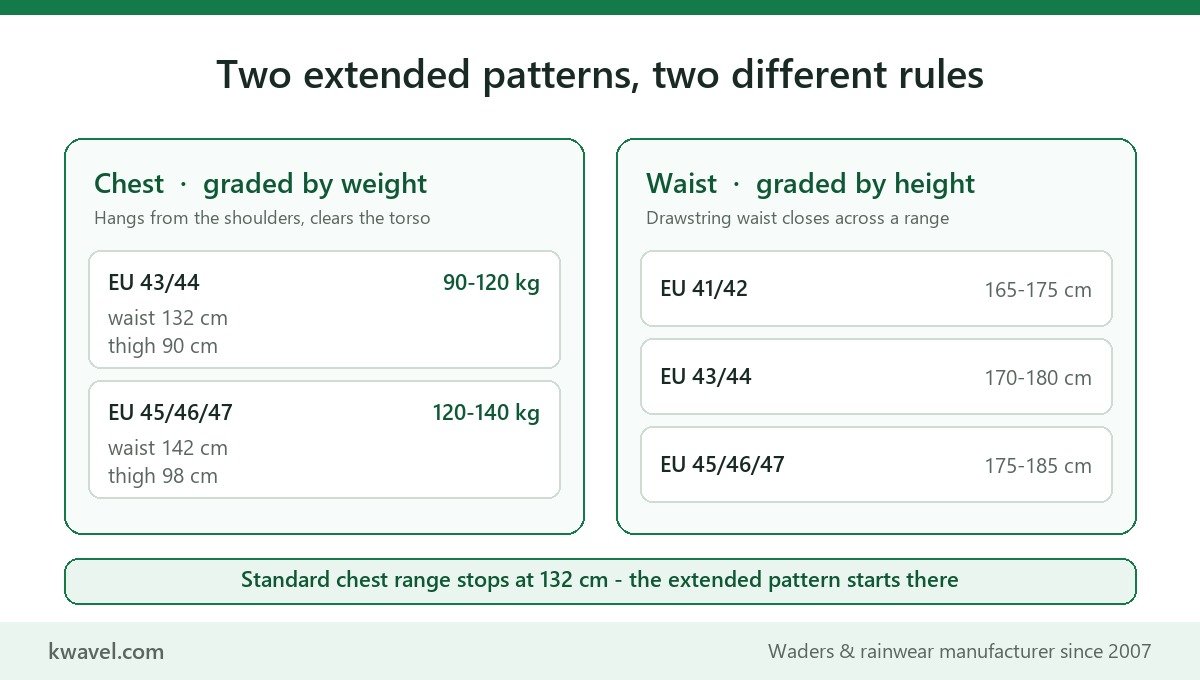
We build two separate extended patterns, because the two wader styles fail in different places. The chest wader carries weight from the shoulders and has to clear the torso; the waist wader hangs from the waist and has to clear the seat and thigh.
Plus size chest waders — selected by body weight
This pattern is graded by the weight range it is built to carry, which is how most of our wholesale buyers ask for it. The two sizes cover 90–120 kg and 120–140 kg.
| Measurement | EU 43/44 | EU 45/46/47 |
|---|---|---|
| Waist (cm) | 132 | 142 |
| Thigh opening (cm) | 90 | 98 |
| Trouser length (cm) | 133 | 143 |
| Body weight the size is built for | 90–120 kg | 120–140 kg |
For reference, the largest standard chest size we make — the injection-boot PVC chest waders — carries a 132 cm waist and an 84 cm thigh opening. The extended pattern starts where that one ends, and adds 6 cm of thigh clearance on the first size alone.
Plus size waist waders — selected by height
The waist pattern runs in three boot sizes and is graded by suggested height, with an elastic drawstring waist that closes across a range rather than at a single number. That is why the fixed waist measurement reads lower than the wearer’s body measurement: the drawstring takes up the difference, and the effective range is wider than the flat number suggests.
| Measurement | EU 41/42 | EU 43/44 | EU 45/46/47 |
|---|---|---|---|
| Total length (cm) | 119 | 120 | 121 |
| Waist, flat (cm) | 106 | 110 | 114 |
| Leg length incl. sole (cm) | 79 | 83 | 87 |
| Leg opening (cm) | 82 | 88 | 94 |
| Suggested height (cm) | 165–175 | 170–180 | 175–185 |
The full model is listed as plus size waist waders, built in 0.65 mm PVC with a wider cut than the standard waist pattern.
Chest or waist: which extended cut to choose
The choice is about where the load sits and how much water the wearer stands in, not about size alone:
- Chest, extended — for standing or wading above the waist, and for work where spray comes at the torso. The load hangs from the shoulders, so the shoulder and chest panel has to be cut for a larger frame; that is the part standard patterns fail at first.
- Waist, extended — for wet ground, shallow pools and warmer climates. Less material over the torso means less heat build-up, and the drawstring waist copes with a body that changes shape through the year.
Both patterns use the same PVC construction and the same 100% heat-welded seams as the rest of the range, so water resistance does not change with size. Full-body suits follow a separate chart again, because the suit carries the torso and arms at once; those measurements sit on the PVC full body waders page. If you are still deciding between styles rather than sizes, the PVC versus nylon comparison covers the material side, and the wader sizing guide covers the standard-range version of this method.
4. Plus Size Waders for Women
Women’s extended sizing is a separate problem again, because the standard women’s patterns are graded on a narrower base. Our women’s chest and waist models run to a 121 cm waist on the largest size, measured on the same basis as the men’s chart. Above that, the practical answer is usually the extended waist pattern with a longer leg rather than a women’s chest cut, because the chest panel on a women’s pattern is proportioned for a shorter torso and will not clear a larger frame comfortably.
Within the standard range, the nylon women’s chest waders run to EU 41 on that same women’s pattern.
Buyers ordering for mixed crews should collect the same three numbers from every wearer — waist, thigh, height — and let the chart do the sorting. Guessing by “looks about a large” is what produces the exchange emails three weeks after delivery. The women’s models are on the women’s waist waders and women’s chest waders pages.
5. Four Fit Failures That Cause Returns
Almost every extended-size return we see traces back to one of four shortcuts. All four are avoidable before the order is placed.
Fitting by boot size only
The boot size says nothing about girth. A buyer who wears a 43 boot may need the extended pattern or the standard one, and the boot column looks identical in both. Always read the waist and thigh rows before the boot row.
Ignoring the thigh opening
A wader can close at the waist and still be unusable if the leg opening binds above the knee. Kneeling is the test: if the wearer cannot kneel without the fabric cutting in, the size is wrong regardless of what the tape measure said at the waist.
Buying for height and hoping the waist follows
Height and girth are independent. A tall, slim buyer and a shorter, heavier buyer of the same height band need different patterns, not different sizes of the same pattern. This is the single most common error in wholesale orders assembled from a list of heights. Getting the pattern right is one line of a first order; the rest is covered in our waders supplier checklist.
Not allowing for winter clothing
Waterproof chest waders are worn over trousers, and in cold climates over a base layer and fleece. Two to three centimetres of ease at the waist and thigh is the difference between a wader that is worn all winter and one that stays in the truck. Measure over the layers, or add the allowance deliberately.
6. Ordering Extended Sizes in Bulk
Extended sizes follow the same commercial terms as the rest of the range: a minimum of 10 pairs per style with sizes mixable inside the order, 60 pairs for a custom requirement, and the sample fee deducted from the bulk invoice. Standard production runs in about 3 days for stock colours and around 7 days for a bulk order.
Two practical notes for a crew order. First, extended sizes normally make up a minority of a working crew, so mix them into the same order rather than placing a separate one — the mixable minimum is what makes this possible. Second, take one sample pair in the extended pattern before a first bulk order. The measurements are on this page, but how a pattern carries weight on a real body is not something a chart can settle, and one sample pair costs far less than a returned container.
Tell us the waist, thigh and height for the largest wearer in the crew and we will confirm which pattern to use before the order is drawn up. Bulk pricing and lead times are quoted through the contact page, and the full model list sits under all products.
7. FAQ
Are plus size waders just larger standard sizes?
No. The extended patterns are graded separately, with a wider thigh opening, a longer rise and a repositioned chest panel. A standard pattern scaled up by two sizes will close at the waist but will not let the wearer kneel comfortably, because the proportions stop matching a real body at that girth.
What size is 2XL in waders?
We do not label waders as S, M, L or 2XL, because those labels have no fixed meaning across manufacturers and they hide the number that actually matters. Every model is stamped with an EU boot size and published with garment measurements beside it. A buyer who normally takes 2XL in clothing is usually in the EU 43/44 extended chest pattern or the EU 43/44 extended waist pattern — confirmed against the waist and thigh rows, not against the clothing label.
Once you have the boot size, the rest of the row can be read straight off the table — including EU to US and UK conversions — on the wader size conversion chart.
Do you make extended sizes in chest waders as well as waist waders?
Yes. The extended chest pattern covers 90–120 kg and 120–140 kg in two sizes, with a 132 cm and 142 cm waist. The extended waist pattern runs in three boot sizes with an elastic drawstring waist. Both are on this page with their full measurement tables.
Can plus size waders be worn over thick winter clothing?
Yes, if the size is chosen for the layers. Measure the waist and thigh over the clothing the wader will be worn with, or add two to three centimetres of ease to a measurement taken over trousers. The extended chest pattern has the most room to work with, since the garment hangs from the shoulders rather than the waist.
What is the minimum order for extended sizes?
Ten pairs per style, with sizes mixable inside the order, so extended sizes can be added to a normal crew order rather than ordered separately. Custom requirements start at 60 pairs. Samples are available before a bulk order and the sample fee is deducted from the bulk invoice.
8. Getting the Size Right the First Time
Three measurements — waist at the natural waistline, thigh at the widest point, height barefoot — plus the two tables above will settle almost every extended-size question. The rule that prevents most returns is simple: when a number falls between two rows, take the larger one, because a wader that is slightly generous gets worn and a wader that is tight gets returned.
If the measurements do not match any row, send them to us anyway. We build the extended patterns ourselves, so a waist that falls between the two chest sizes can usually be resolved by confirming which dimension matters more for the work the wearer does — kneeling, climbing or standing in water all day. Related reading: waders for work, waders for farming, and wader repair and care.
Message us on WhatsApp at +86 188 3050 5126 or use the contact form — tell us the waist, thigh and height range your market buys, and we will quote within 24 hours.