
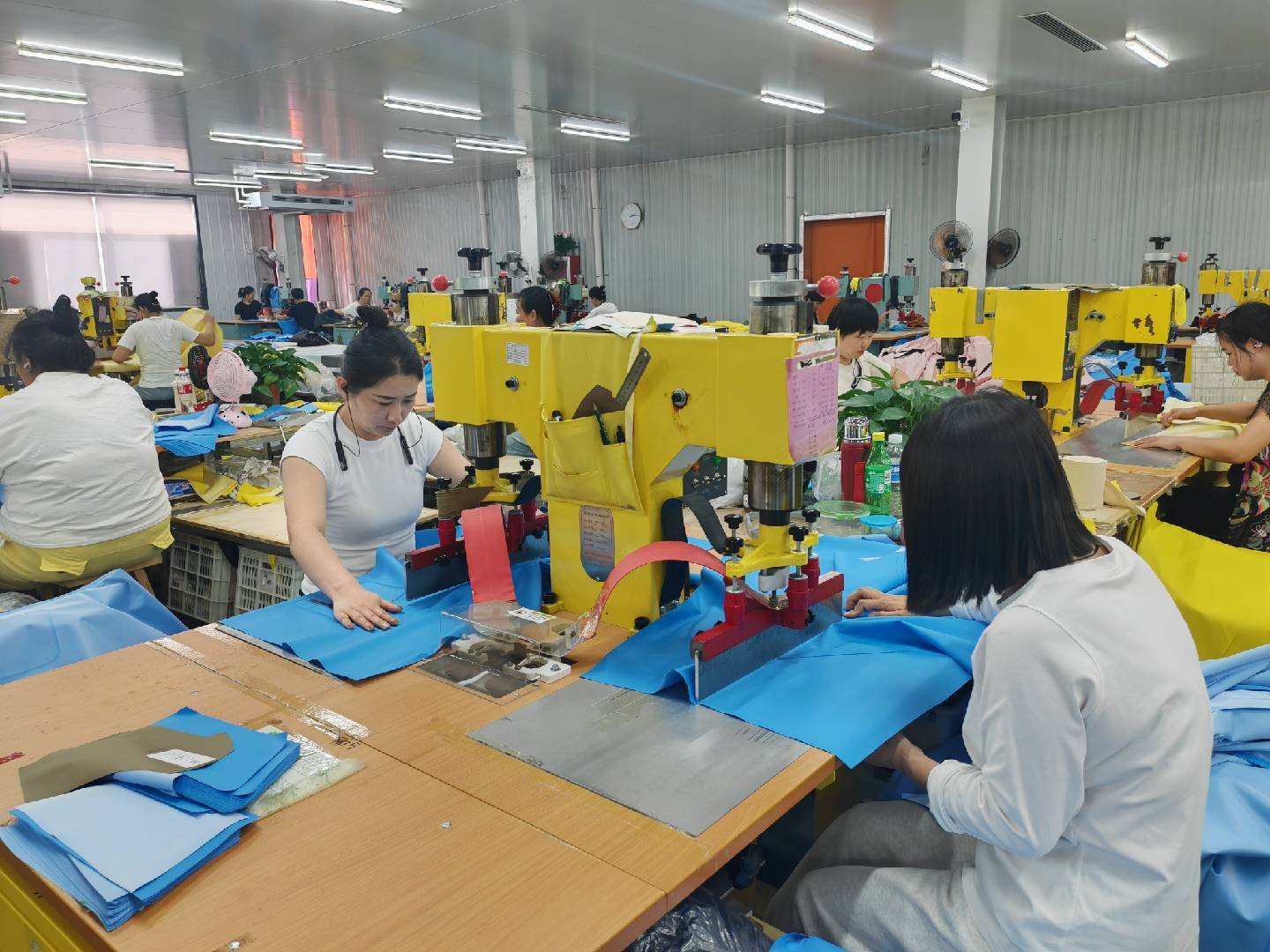
Searching for a waders supplier is not the same job as searching for a pair of waders. A retail search ends at a product; a supplier search ends at a relationship that has to survive a season of reorders, a container of mixed sizes, and the one complaint that always arrives eventually. The criteria are different, and most of the information online about waders is written for the person wearing them, not the person importing them.
This guide is written from the other side of the table. Kwavel is a waders manufacturer in Tangshan, Hebei — we run the production line, we quote the MOQ, and we are the factory a buyer comes to audit. What follows is the checklist we wish every serious enquiry already had: what to ask, what the answers mean, and which ones should end the conversation early.
1. Three Kinds of Waders Supplier, Three Different Risks
The word “supplier” hides three business models, and the price you are quoted usually tells you which one you are talking to.
The manufacturer
A factory owns or leases the equipment: high-frequency welding machines, cutting tables, sewing lines, and the moulds for injection boots. It buys coated fabric by the roll and converts it. A manufacturer can change the thickness, the boot, the colour and the packaging, because it controls the process that produces them. It cannot offer you 400 unrelated products.
The trading company
A trading company buys from factories and resells, often across many categories. Good ones add real value: consolidation, inspection, documentation, and English that is answered at 3am. The risk is not that they exist — it is that the factory behind them is invisible, so nobody can answer when you ask why the 0.6 mm fabric became 0.45 mm.
The wholesaler or marketplace seller
These hold stock and sell in small quantities. Fine for a test order, useless as a long-term source, because they cannot make anything and will not be there when you need a repeat in a specific thickness.
None of the three is wrong. What matters is that you know which one you are buying from, because only one of them can fix a production problem. If your plan is to build a private label, the manufacturer is the only one of the three that can deliver it.
2. How to Tell a Factory From a Trading Company in One Call
You do not need an audit to find this out. A ten-minute video call is enough, and a supplier who will not do it has answered the question for you.
- Ask to see the line running. Not a showroom, not a catalogue — the welding machine, with today’s production on it. A factory can point a phone at its own equipment at any hour of the working day.
- Ask what the machines make when they are not making waders. A waders factory runs welding and sewing for waterproof products. A trading company will describe a product range; a factory will describe a process.
- Ask a technical question and see who answers. “What happens to the seam if I go from 0.45 mm to 0.8 mm PVC?” is a question a production manager answers directly and a sales agent forwards to someone else.
- Ask for the mould list. If a supplier offers injection boots, it either owns the moulds or buys the boots. Both are legitimate, but they are different answers with different cost structures.
- Ask about the address. Ours is Hongqiao Industrial Park, Yutian County, Tangshan City, Hebei. Buyers are welcome to visit, and we also do a live video tour over WhatsApp for those who cannot travel — the invitation is on our about page.
3. The Questions to Ask Before the First Order
Ask these in writing, before the sample, and keep the answers. They become the reference when the second order is discussed.
| Question | Why it matters | A good answer |
|---|---|---|
| What is the MOQ, per model and per order? | MOQ is where a supplier tells you what its line can actually do | A specific number, with a lower one for the simplest model |
| Can models and sizes be mixed in one order? | Mixing is what lets a first order cover a real size range | Yes, with a stated minimum per size |
| Is the sample charged, and is it refunded? | Free samples attract enquiries nobody intends to convert | Charged, and credited against the bulk order |
| How long does a sample take, and how long does bulk take? | The two are different processes with different clocks | Two different numbers, not one |
| How are the seams joined? | This is the single biggest predictor of leaks | Heat-welded, on 100% of seams |
| What thickness do you actually produce? | Thickness is where a quote quietly gets cheaper | A stated range in mm, and which one you are being quoted |
| Which sizes exist, and what does the size cover? | Boot size alone is not a wader size | A size table with height and girth, not just EU numbers |
| What certifications do you hold? | Athleisure-quality paperwork is common in this category | Named standards, with report numbers you can check |
| What payment terms do you work on? | Terms tell you how a supplier handles risk | Deposit and balance, or a letter of credit |
4. MOQ: The Number Behind the Number
Minimum order quantity is not a sales tactic invented to annoy small buyers. It is the point at which a production changeover stops losing money. Every time a line changes colour, thickness or size, it stops producing and produces waste while it settles. The MOQ is where that cost becomes worth carrying.
What that means in practice for a waders line:
- Simple models carry a low MOQ. Our full body waders start at 5 pairs, because the pattern and the material do not change between them. See the PVC full body waders for the model this applies to.
- Standard models sit at 10 pairs. Chest, waist and hip waders in existing colours and thicknesses — for example the PVC chest waders with injection boots.
- Custom work starts at 60 pairs. Custom covers a new colour, a new thickness, your own label, or a packaging change. Below that, the changeover costs more than the order.
- Models can be mixed. A first order does not have to be 10 pairs of one thing. Our MOQ applies per model, and sizes within a model can be mixed, which is what lets a distributor cover EU 36 to 47 without buying depth they cannot sell.
If a supplier quotes you an MOQ with no structure behind it — no difference between stock and custom, no mention of mixing — treat it as a sign that the number was chosen for the quotation, not for the line.
5. Samples: What to Order and What to Inspect
Order the sample in the thickness and the size you intend to sell, not the one that is cheapest to send. A sample in 0.45 mm tells you nothing about whether 0.8 mm will weld cleanly on the same machine.
We charge for samples and credit the cost back against the bulk order. That is deliberate: a free sample programme is a sample programme for people who were never going to order, and it slows down the samples that matter.
When the sample arrives, four checks tell you most of what you need:
- Pull at the seam, do not look at it. Seam failure is the most common complaint in this category. On a heat-welded seam the joint is one continuous surface; if you can find a needle line, it was stitched and taped, and the tape is the part that will fail first.
- Measure the thickness with a gauge, not by feel, and at the leg rather than the foot where the material is usually thicker.
- Check the size against the table, not the label. Ask for the height and the girth the size is cut for — our wader size conversion chart is the reference we send, and it is worth comparing before you commit to a size range.
- Put the boots on a hard wet floor. Sole compound and tread pattern are the two things no photograph shows and the two things a work crew will complain about first. For wet industrial ground, the selection logic in our waders for work guide applies directly.
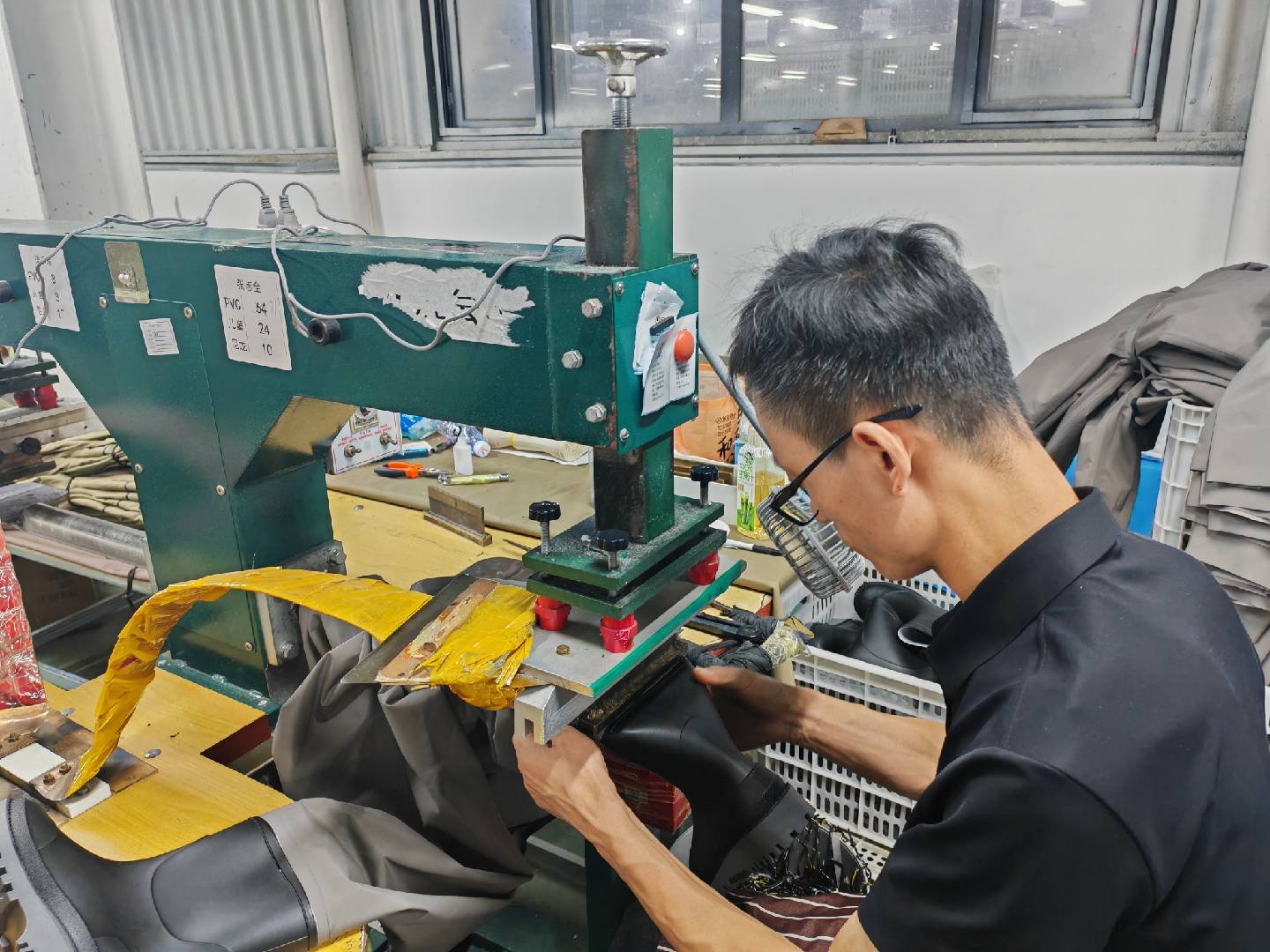
6. Lead Time: What the Quoted Days Do and Do Not Include
Two clocks run on every order, and a supplier who quotes one number for both is hiding one of them.
A sample or a small repeat order from existing material leaves in about 3 days. A full production order takes about 7 days, because the fabric has to be cut to the pattern and the line has to be set up for it.
What is not in either number, and what you should add yourself:
- Custom development. A new colour, a new label or a new size range adds development time before the 7 days even start.
- Seasonal load. Waders are seasonal. A line that is quiet in March is not quiet in August.
- Freight. Seven days of production and four weeks on the water are different problems. Bootfoot waders take more carton volume per unit than flat-packed garments, and that shows up in both the freight quote and the warehouse bill.
- Documentation. Packing lists, certificates and any inspection you require are arranged in parallel, not afterwards, if the supplier is used to exporting.
7. Payment Terms and How Not to Get Burned
Terms are not just about cash flow; they are a signal about how a supplier handles its own risk.
- T/T, 30% deposit and 70% before shipment is the standard arrangement in this industry. The deposit covers material, the balance covers the finished goods.
- A letter of credit at sight works for larger orders and for buyers whose banks require it. It costs more in bank fees and takes longer to arrange.
- Platform trade assurance through Alibaba is available, and it is reasonable to use it for a first order with a supplier you have not met.
- 100% in advance with no track record is the one to avoid. If a supplier will not accept any structure that protects you at all, you have learned something important before paying.
8. Certifications: What to Ask For, and What It Is Worth
Certificates in this category are easy to print and easy to over-trust. Two things matter: which standard is named, and whether there is a report number attached to it.
Waders sold into the EU are normally CE marked, and the marking has to sit behind a real conformity assessment — a certificate with an issuing body and a number, not a logo on a PDF. Domestically in China, the relevant evidence is the national quality test report against the GB standard for the product type. We hold both, and we would rather be asked for the report number than for the artwork.
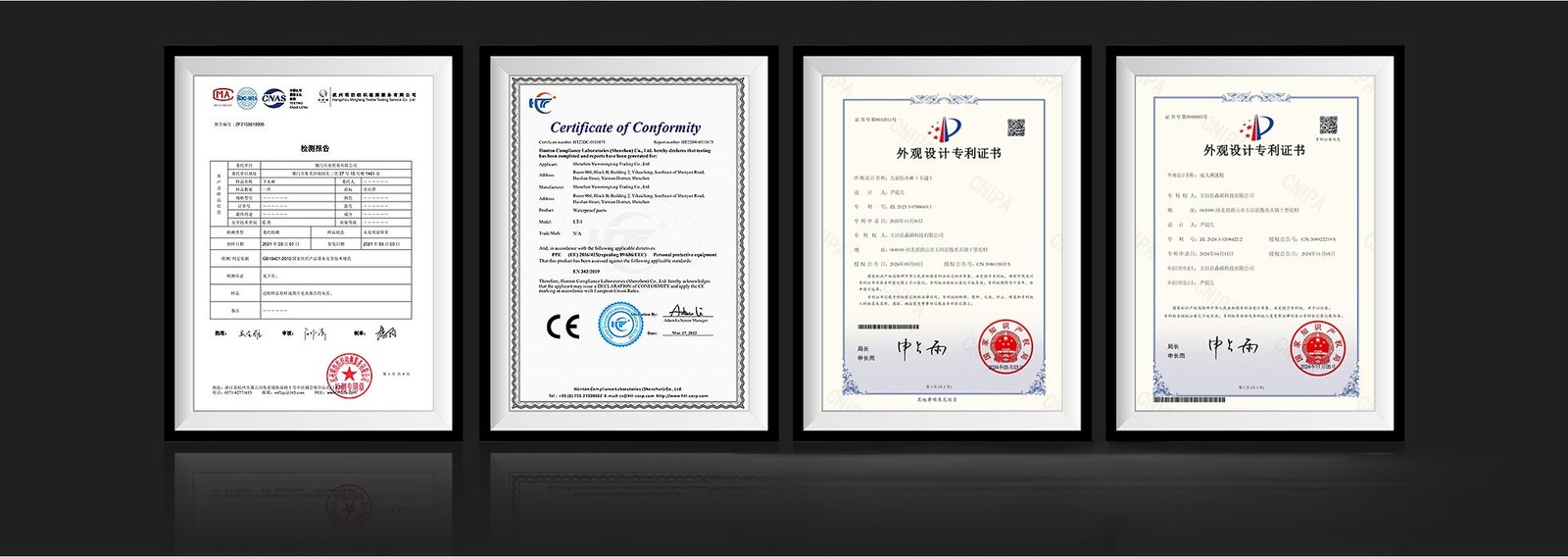
One more thing worth checking: certifications are issued for a specific product and a specific construction. A certificate for a 0.45 mm PVC chest wader does not cover a 0.8 mm full body wader. If you are importing a range, confirm which models the paperwork actually names.
9. OEM and Private Label: What Can Actually Be Changed
Private label is where a manufacturer and a trading company separate permanently, because every item on this list requires control of the production process.
- Material and thickness. PVC and nylon or taslan, in the thickness the application needs — our children’s waders are built at 0.35 mm so they are not stiff to walk in, and adult work models run 0.45 to 0.8 mm. The trade-offs are laid out in our PVC vs nylon waders comparison.
- Boot type. Injection PVC boots, German-style boots or a light sports boot, depending on the ground the wearer stands on.
- Coverage. Chest, waist, hip or full body, and the feature set that goes with each — our chest waders and full body waders ranges show the variations that already exist.
- Colour and camo. With a 60-pair minimum for custom work.
- Branding. Your label, your print and your packaging.
- Size range. EU 22 to 36 for children, 37 to 41 for women’s models and 36 to 47 for men’s — the full breakdown is in the how to size waders guide.
10. A Supplier Scorecard You Can Actually Use
Score the shortlist before you negotiate, while you are still willing to walk away.
| Check | Pass looks like | Fail looks like |
|---|---|---|
| Production is visible | Live video of the line, or a visit | Showroom photos only |
| MOQ has structure | Different numbers for stock, mixing and custom | One flat number for everything |
| Seams are heat-welded | 100% welded, stated up front | “Sealed” or “waterproof”, unspecified |
| Thickness is specific | Millimetres, named on the quote | “Heavy duty” as a spec |
| Size data exists | A table with height and girth | Boot size only |
| Certificates are traceable | Standard plus report number | Logo PDF, no number |
| Lead times are split | Sample and bulk quoted separately | “Fast delivery” |
| Terms protect both sides | Deposit plus balance, or L/C | 100% up front, no alternative |
11. Frequently Asked Questions
What is a reasonable MOQ for a first waders order?
It depends on whether you are buying stock or developing something. For existing models, 10 pairs per model is workable for most importers, and 5 pairs for full body models. For anything custom — a new colour, your label, a new thickness — the practical floor is 60 pairs, because the line has to be set up for you.
Why do suppliers charge for samples?
Because samples are made on the same machines as production, and free samples attract enquiries that were never orders. The usual arrangement, and ours, is to charge for the sample and credit it against the bulk order, so the cost disappears if the order happens.
How do I know the waders will not leak?
Ask how the seams are joined before you order, and test it on the sample. Heat-welded seams fuse the material into one surface and are what we use on 100% of seams. Stitched-and-taped seams can be made waterproof, but the tape is the part that ages first and the part that fails.
Can I put my own brand on the waders?
Yes, at the custom minimum of 60 pairs. Label, print, packaging, colour, thickness, boot type and size range can all be specified. What cannot be changed cheaply is the mould for an entirely new injection boot — that is a development cost, and it is worth asking about separately.
What is the difference between a waders supplier and a waders manufacturer?
A manufacturer runs the line and can change the product. A supplier, in the trading sense, buys and resells and usually cannot. Both can be the right partner for a given order; only one of them can be the right partner for a private label.
12. Where We Fit
We are a manufacturer, not a trading office: the welding machines, the sewing line and the injection boots are ours, in Hongqiao Industrial Park, Yutian County, Tangshan. Every seam we ship is heat-welded, thickness is quoted in millimetres, and the size tables we send include height and girth rather than a boot number.
If you are comparing waders suppliers and want the answers in the format above, send the models you are pricing and the quantities you have in mind. A video call of the line is easier than a paragraph, and we would rather you saw it before you ordered than after.
Talk to the factory directly: WhatsApp +86 188 3050 5126, or use the contact form for quantities, thickness and a size range.