
Buying waders for farming comes down to four decisions: the type (hip, waist, chest, bib or full body), the PVC thickness, the boot and sole style, and the size range your crew actually needs. Get those four right and a pair lasts a whole season of pond work; get them wrong and you are replacing split seams every month. This guide walks farm, fishery and work-crew buyers through each decision, using the thickness, size and MOQ facts from our own factory floor. If you are unsure which height your crew actually needs, our hip waders vs chest waders comparison walks through what each one covers, where each fails, and how to split an order across two heights.
Kwavel is a waders and rainwear manufacturer in Hebei, China, producing both PVC and nylon models since 2007 for wholesale buyers across South America, Europe and Southeast Asia. Everything below reflects what we manufacture and ship every week — not catalog theory.
1. Match the Wader Type to the Job
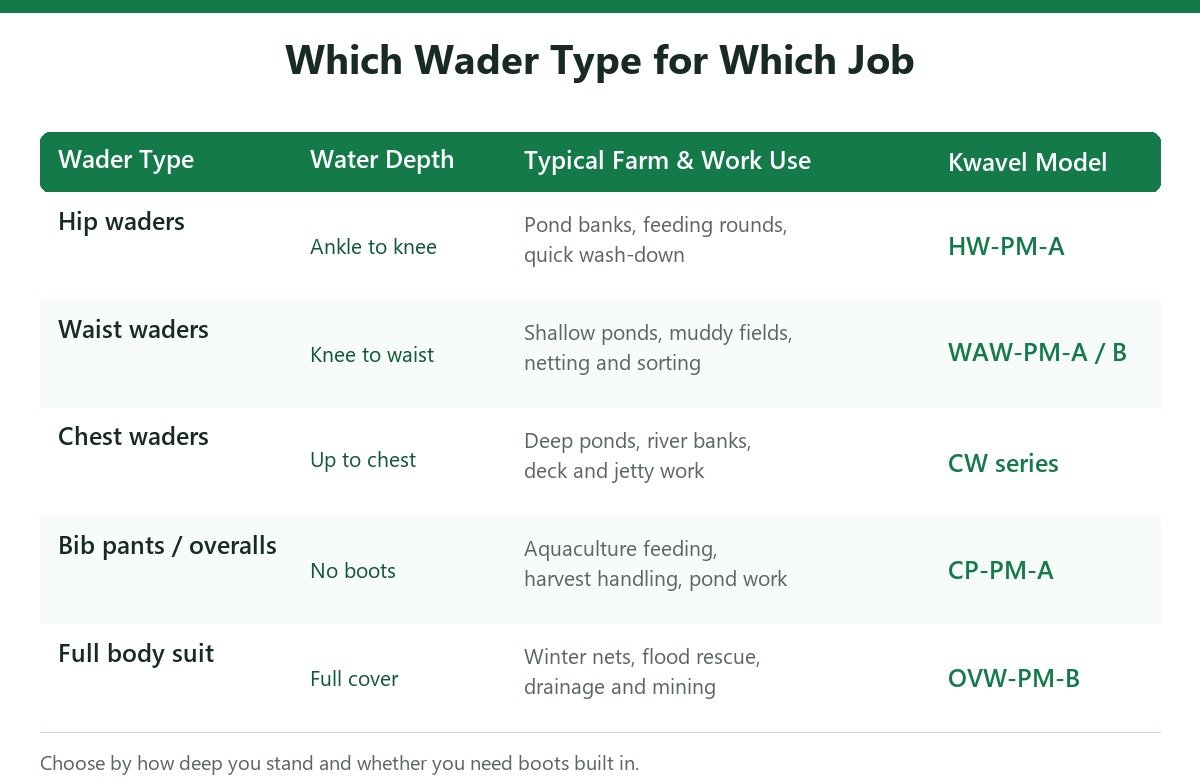
Choosing waders for farming starts with one question: how deep do you stand, and do you need boots built in?
Hip Waders — Shallow, Quick Jobs
Hip waders stop at the thigh and are the lightest to walk in all day. They suit pond banks, feeding rounds and quick wash-down work where you rarely go deeper than the knee. See our PVC hip waders with boots for the classic version.
Waist Waders — Knee to Waist
Waist waders cover muddy fields, shallow ponds and netting work where water comes up to your waist but not higher. They pack small and dry fast, which is why crews moving between ponds like them. Our PVC waist waders come in 15 colors including camouflage for hunting-adjacent work.
Chest Waders — Deep Water and Cold Days
Chest waders are the default for deep ponds, river banks and jetty or deck work, and they double as rain protection in a downpour. The full chest waders line covers PVC and nylon models from kids’ sizes up to men’s EU 47.
PVC is not the only option for deep water. Crews who walk long distances between ponds usually prefer the lightweight nylon chest waders, which pack smaller and weigh less over a full day.
Bib Pants and Full-Body Overalls — When You Take the Boots Off
For aquaculture feeding, water-quality checks and harvest handling, many crews prefer bib pants: chest-high coverage with normal footwear, so the same pair works on land and in shallow water. Our PVC bib pants with a waterproof zip pocket are built exactly for this. When the job turns extreme — winter nets, flood response, drainage — a full-body suit with hood, gloves and welded boots keeps the whole body in one continuous shell: see our heavy duty PVC rain overalls.
2. PVC Thickness: 0.35 mm to 0.8 mm
Thickness is the durability-versus-weight dial. Thicker PVC resists abrasion and puncture better; thinner PVC is lighter and bends easier. The right answer depends on your ground, not on a universal “best”.
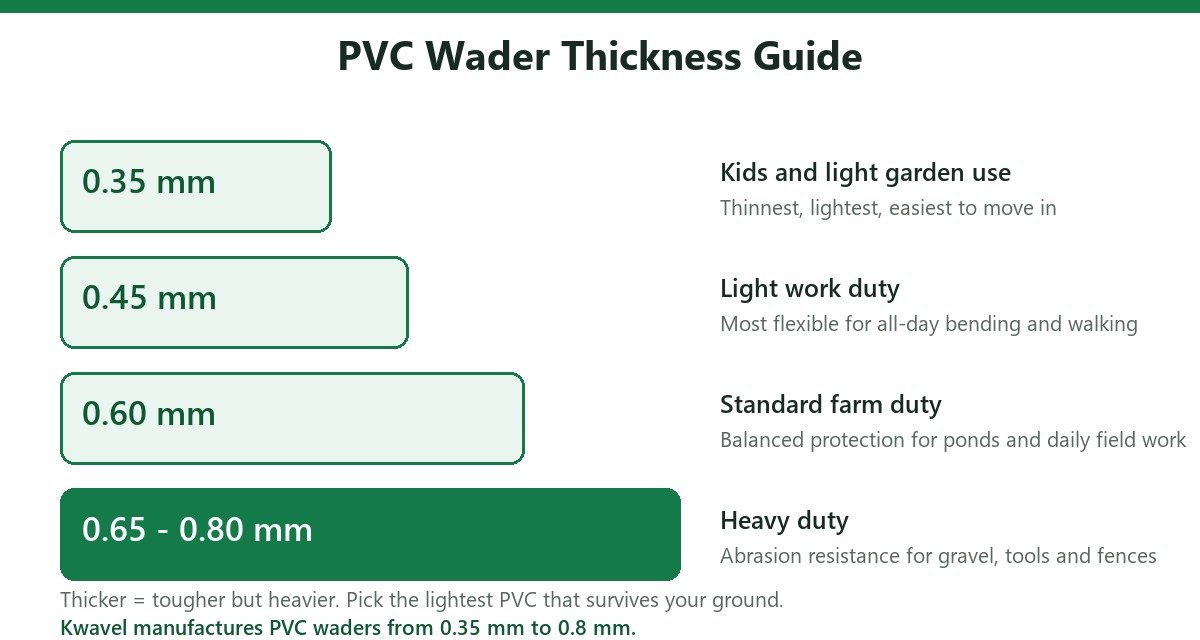
- 0.35 mm — kids’ models and light garden use: the thinnest and lightest, easiest to move in.
- 0.45 mm — light work duty: the most flexible for all-day bending and walking; our full body waders use it.
- 0.60 mm — standard farm duty: balanced protection for ponds and daily field work.
- 0.65–0.80 mm — heavy duty: abrasion resistance for gravel, tools and fence lines; our rain overalls run 0.8 mm.
Rule of thumb: pick the lightest PVC that survives your ground. Crews kneeling in gravel or dragging nets need the heavy end; feeding rounds on soft pond banks do not.
If the job is mostly kneeling — net mending, pond repair, planting — the thickness number matters less than the knee itself: our double-knee chest waders carry a second PVC layer over the point that wears through first.
3. Boots and Soles
Three things to check before you order. First, how the boot attaches: an integrated PVC injection boot welded at the ankle has no stitch line to leak, which is why most of our waders are built this way. Second, the boot shaft material: nylon-top boots breathe better in hot climates, full PVC is easier to rinse clean. Third, the sole: a cleated PVC sole grips wet clay and algae-covered stone, and if your crew works around nails or sharp debris, ask the supplier about a puncture-resistant midsole before ordering. For crews that prefer separate footwear, we also make waterproof fishing boots. Why we build the boot into the wader instead of selling the two pieces separately is covered in our bootfoot vs stockingfoot waders guide.
4. Sizing a Whole Crew
Waders follow EU shoe sizing: kids 22–36, women 37–41, men 36–47. Size by the wearer’s height and weight first — the boot size matters less than whether the body fits over work clothes. For a crew order of waders for farming, mix sizes freely: our MOQ is 10 pieces (5 for full-body suits) and sizes and models can be mixed within one order, so a six-person crew does not have to buy six identical pairs. Kids’ and special-fit models live in their own kids & special fit category. For non-farm crews — docks, construction, drainage — the same sizing rules apply; see our guide to waders for work. Sizing numbers in one place: our guide on how to size waders has the EU, US and UK conversion tables ready to print.
5. Seams: Why Hot-Welded Beats Sewn
Every stitch in a sewn wader is a needle hole through waterproof fabric — the first place cheap waders leak. Heat-welded seams fuse the PVC panels into one piece, so the suit stays 100% waterproof at every joint for the life of the product. When you compare suppliers, this is the single most useful question to ask: are the seams welded or stitched? And when a seam does eventually fail, it can be patched rather than replaced — our guide to repairing leaking waders at seams covers it.
6. Supplier Checklist Before You Order
- MOQ and size mixing — confirm the minimum and whether sizes can be mixed (ours: 10 pieces, 5 for full-body).
- Sample policy — a sample should ship in days, and the fee should be credited back on the bulk order.
- Lead time — regular models in about 3 days, bulk orders around 7 days.
- OEM/ODM — custom color, logo and packaging from 60 pieces if you sell under your own brand.
- Certification and factory access — CE and national standard compliance, and a factory that welcomes visits (ours has run since 2007 in Hebei, China).
- Payment terms — T/T 30/70, L/C or Alibaba trade assurance, so neither side carries all the risk.
Frequently Asked Questions
What thickness of waders is best for farm work?
For adult crews, 0.45–0.8 mm PVC covers most farm and fishery work: 0.45 mm for light duty and long walking, 0.6–0.8 mm for gravel, tools and heavy abrasion. Kids’ models run 0.35 mm.
Can I order mixed sizes in one bulk order?
Yes. Our MOQ is 10 pieces (5 for full-body suits) and you can mix sizes and models within the same order.
Do you provide samples before bulk production?
Yes. Samples of regular models ship in about 3 days, and the sample fee is credited back on the bulk order.
Do you offer custom colors or logos?
OEM and ODM start at 60 pieces: custom color, your logo and your packaging.
How fast can you deliver?
Regular models ship in about 3 days; bulk orders take around 7 days depending on quantity.
Get a Quote for Your Crew
Still deciding between materials? Read our PVC vs nylon waders comparison first. Ready to price a fleet? Browse the full chest waders, waist waders and fullbody waders lines, then Message us on WhatsApp at +86 188 3050 5126 or send the contact form — tell us your water depth, ground conditions and crew size, and we will recommend a model and quote within 24 hours.