

How to size waders comes down to two numbers that have nothing to do with each other: the boot size, which decides how your feet fit, and the garment size, which decides whether the body of the wader fits your height and build. Buyers who treat wader sizing as one number are the ones who get returns. This guide walks through the three steps we give wholesale customers — measure, convert, check the height — plus the ranges we actually produce and what to ask before ordering a crew’s worth of pairs.
Kwavel is a waders and rainwear manufacturer in Hebei, China, producing PVC and nylon models since 2007 for wholesale buyers in South America, Europe and Southeast Asia. Every measurement below comes from our own production size charts, not from a general conversion table.
1. Why Wader Sizing Is Different
With ordinary trousers you pick one size. With waders you are fitting two separate things at once, and they are independent:
- The boot — sized like footwear. It decides comfort and whether a crew can walk all day.
- The garment — chest waders and full-body suits cover the torso, so total length, chest and inseam decide whether you can bend, kneel and reach without pulling at the shoulders.
A size 43 boot can come on a wader that fits a 170 cm buyer or on one built for 185 cm. That is why a shoe-size-only size chart cannot be answered with a single column — and why the chest waders, waist waders and fullbody waders pages all list garment measurements next to the boot sizes. Hip waders are the exception: they stop at the thigh, so their table carries pant length and leg circumference instead of chest or waist — our hip waders vs chest waders guide explains which numbers to compare at each height.
Where size charts usually go wrong
Most charts online show only the EU-to-US conversion. That tells you which boot to choose, but nothing about whether the body will fit. Our charts carry four rows of garment data — total length, chest or waist, leg opening and inseam — plus a fits-height row on full-body models, measured barefoot.
2. How to Size Waders in Three Steps
This is the method we send to first-time wholesale buyers. It takes about five minutes per person and prevents almost every sizing email that follows a first order.

Step 1 — Measure the foot length, standing
Put a sheet of paper against a wall, stand on it with the heel touching the wall, and mark the tip of the longest toe. Measure heel to mark in centimetres. Do it in the afternoon, when feet are at their largest, and in the socks the wader will be worn with. Foot length in cm is the one measurement that travels across every sizing system — when a US or UK number is in doubt, the centimetres are not.
Step 2 — Convert to a boot size
Read the foot length against the conversion table in the next section, then take the EU column as the ordering size. We stamp EU sizes on every boot we ship, so the EU column is the one that matches our production.
Step 3 — Check the garment against your height
Now go to the garment table for the model you want. Compare your own height and waist with the rows, not just the boot size. On full-body models, the fits height row is the fastest filter: if your height sits at the top of a size’s range, take the next size up.
3. Boot Size Conversion: EU, US and UK
These tables are the numbers behind how to size waders, and they follow common international work-boot sizing. US and UK numbers can shift by half a size between brands, so treat the foot-length column as the tiebreaker.
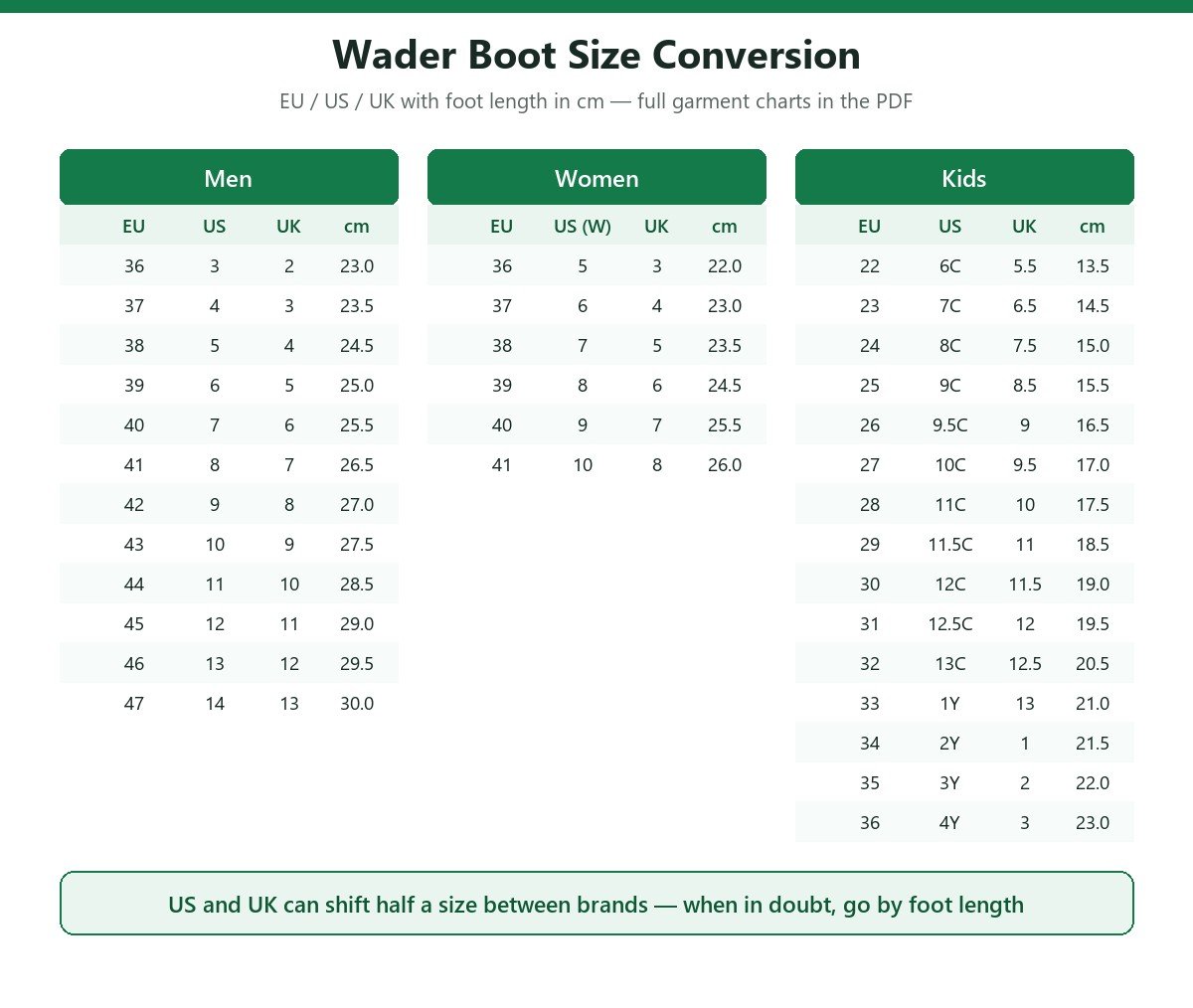
Men: EU 36–47 — EU 40 is roughly US 7 / UK 6, foot length 25.5 cm; EU 43 is about US 10 / UK 9, 27.5 cm. The full range is available on our injection-boot PVC chest waders.
Women: our women’s models run EU 37–41 — EU 38 is roughly US 7 / UK 5, foot length 23.5 cm. Women’s models are cut on a women’s pattern, not a small men’s pattern: see our nylon women’s chest waders. The PVC version is the women’s PVC chest waders with zip pocket, in five colours and EU 36–41.
Kids: EU 22–36 — from toddler sizes up to youth, so a kids’ wader can be reordered as a child grows. EU 30 is about US 12C / UK 11.5, foot length 19 cm.
The full document is a two-dimensional chart: boot conversion on the front, garment measurements for every model we make behind it. Download the full wader size chart (PDF, A4) and print it for the warehouse wall — printed charts are how warehouse teams actually size a batch.
Every number above is also published as a standalone reference you can bookmark or share with your team: our wader size conversion chart lists EU, US and UK boot sizes alongside foot length and garment measurements for each model.
4. Reading the Garment Measurements
Garment tables list the finished garment in centimetres and the measurements are taken flat. Four rows matter most:
- Total length — waist waders run about 103–118 cm, chest models around 120–136 cm, full-body suits 170–190 cm depending on boot size. This is the number that decides whether a chest wader reaches the wearer’s chest or bunches at the waist.
- Chest or waist — the circumference when laid flat, doubled in real wear. Choose it with the layers the buyer wears underneath, not bare body measurements.
- Leg opening and inseam — check these for very tall or very short wearers; inseam only shifts by about 8 cm across the whole size range.
- Fits height — on full-body models we publish the height each size is built for: 160 cm at EU 36/37 up to 183 cm at EU 45/46/47, with a size 40 cut for about 170 cm. It is the quickest honest filter for online buyers, and it is listed on our PVC full body waders page.
5. The Three Sizing Mistakes That Cause Returns
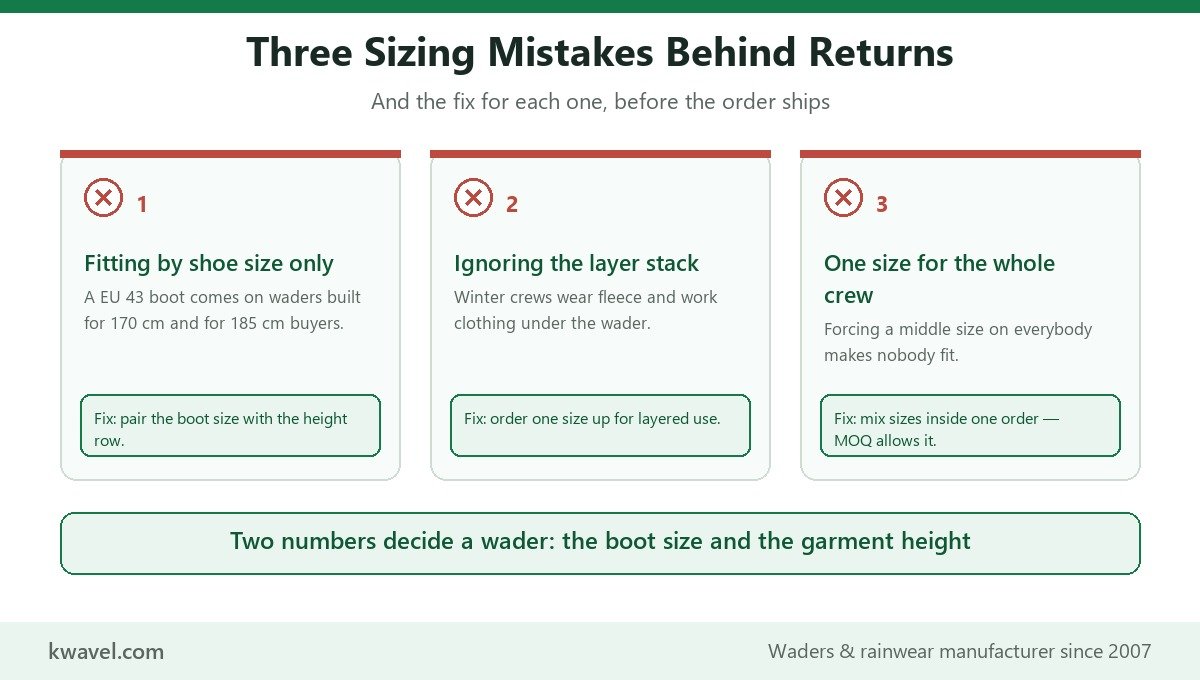
Almost every sizing problem we see traces back to one of three things — all of them shortcuts taken while working out how to size waders for someone else.
- Fitting by shoe size alone. A boot size of 43 exists on waders built for three different body heights. Always pair the boot size with the garment table.
- Ignoring the layer stack. Winter orders are worn over fleece or work clothing. If crews layer up, order one size up rather than a heavier sock — our waterproof insulated overalls exist exactly because padded clothing underneath changes the fit.
- Ordering one size for a whole crew. Sizes can be mixed inside one order, so a batch can carry 41 for one worker and 45/46 for the next. Ask for mixed sizes instead of forcing a middle size on everybody — and when the hazard is rain from above rather than water below, the same crew often needs a waterproof rain suit instead of a wader.
6. Kids’ and Women’s Waders
The two ranges that get the most sizing questions, for opposite reasons.
Kids’ sizes run 22–36
Our children’s models start at EU 22/23 and go to EU 36, in paired size steps (22/23, 24/25 and so on). Kids’ PVC is 0.35 mm, thinner than adult film so children can move. Children also grow fast, which is why a kids taslan chest wader is usually bought with the next size up in the same order.
Women’s sizes are their own pattern
Women’s models run EU 37–41 with a narrower shoulder cut and shorter body; our women’s waist waders are a good example. Do not size women by jumping down into the smallest men’s size — the fit lands in the wrong places.
7. Big and Tall: Beyond the Standard Range
The standard men’s range covers 0.45–0.8 mm PVC from EU 36 to 47, but a part of the market sits outside it. Our plus size waist waders are a separate pattern: two codes only, sized by weight rather than shoe size, with a waist of 132 cm for 90–120 kg and 142 cm for 120–140 kg. Tall wearers who sit at the top of a standard size should size up rather than rely on stretch — the garment is a fixed measurement. The two extended patterns are covered in detail in our plus size waders guide, with the measuring method and how an extended cut differs from scaling up a medium pattern.
8. Sizing a Whole Crew and Ordering in Bulk
For distributors, sizing stops being about one pair and becomes about one purchase order. The practical numbers at Kwavel: MOQ 10 pieces per regular model, 5 for full-body suits, and sizes and models can be mixed in a single order. Fully custom designs start at 60 pieces. Samples ship in about 3 days and the sample fee is credited back against the bulk order; bulk runs in around 7 days, with payment by T/T 30/70, L/C or Alibaba trade assurance. For the rest of the buying process — samples, certifications and payment terms — see our waders supplier checklist.
A workable way to collect sizes: ask every wearer for foot length in cm and height, then convert once for the whole list — the same three steps, repeated across a workforce. Crews that order by height plus foot length in one batch are the ones that reorder the same sizes the next season; the process itself is detailed in our waders for work guide, and crews who keep their own boots usually pair waist models or PVC bib pants with separate footwear.
Frequently Asked Questions
How do I know what size waders I need?
Two measurements: foot length in cm for the boot, and your height plus chest or waist for the garment. Match the foot length to the conversion table, then check the garment rows for the model. If you only have a shoe size, the EU size is the safest starting point.
What size waders do I need if I am between sizes?
Size up. Waders are worn over clothing and a slightly roomier body hangs better than a tight one, which pulls at the shoulders when you bend. If the doubt is only in the boot, go by foot length instead.
Are kids’ wader sizes the same as shoe sizes?
Yes in principle — our kids’ range runs EU 22–36 in paired steps and matches children’s shoe sizes. Because the garment grows with the boot size, reordering one size up each season is normal practice.
Do your sizes match other brands?
EU boot sizes are standard, so a EU 43 is a EU 43. US and UK conversions can shift by half a size between brands, and garment cuts differ more: our chest waders are cut for layering, so the same EU size may feel roomier than a slim fishing brand.
Can one order contain mixed sizes?
Yes. MOQ is 10 pieces per model (5 for full-body suits) and sizes or models mix freely inside that quantity — so a crew order can hold several sizes without buying a full carton of each.
Get the Size Right the First Time
Measure the foot, convert to EU, then check the garment against height — and print the chart for the people doing the ordering. Browse the ranges by category: chest waders, waist waders, fullbody waders, kids’ and special fit, rain boots and rainwear. Separate footwear for crews that prefer it is covered by our waterproof fishing boots, hip-height work by the PVC hip waders, and repairs by the wader repair and care guide. For how to match a wader to the working conditions rather than the size, the farming and material guides cover the rest.
Send us your size list and we will confirm the codes, thickness and boot type for each line: Message us on WhatsApp at +86 188 3050 5126
, or the contact form. Sizing questions from distributors get answered within 24 hours, and a sample pair can be on its way in about 3 days.